

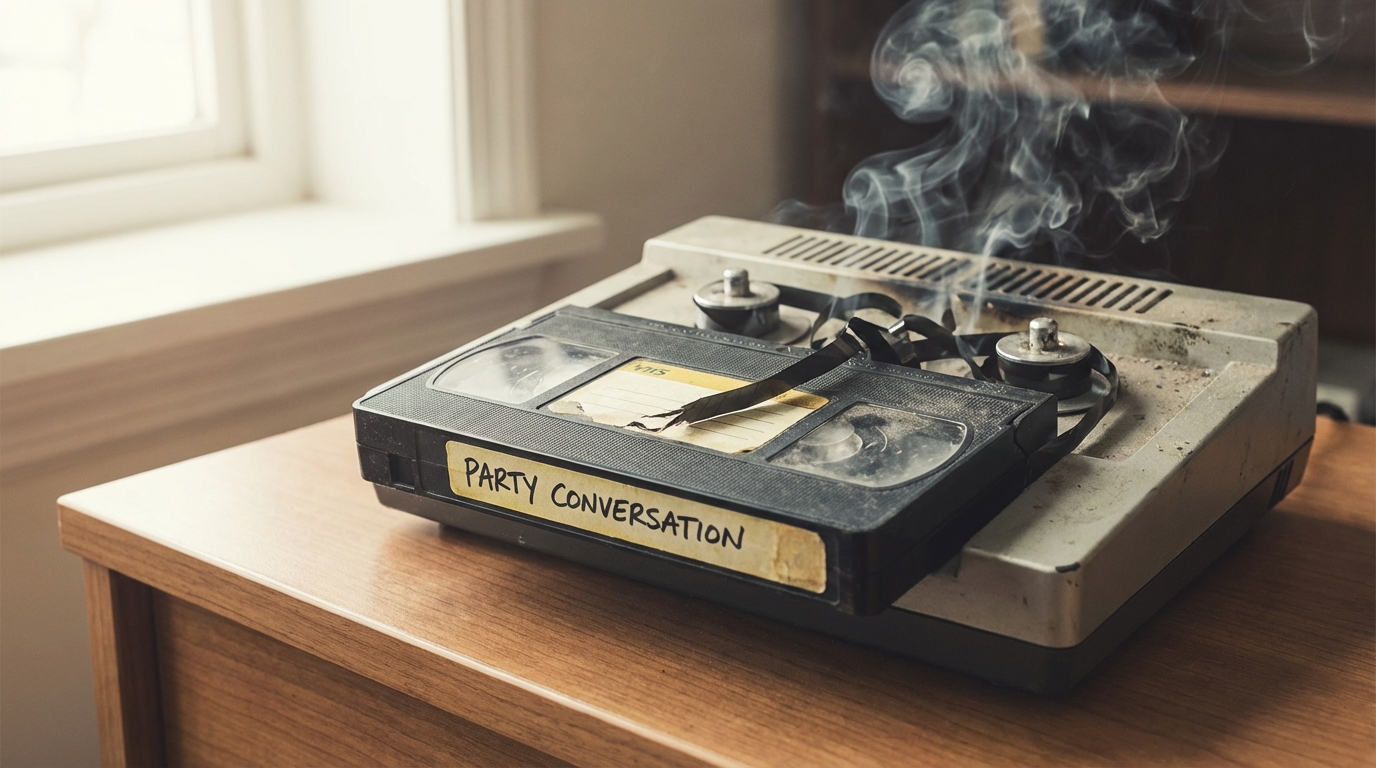
After reading this, you won't replay social situations fifty times before bed. Coming home will finally mean coming home — not starting a mental prosecution.
You come home from a social event and the replay starts. That moment when you asked a question and got a short answer—did you say something wrong? Was it boring? You run through it again. And again. Fifty times, maybe more, trying to pinpoint what went wrong so you can avoid the same mistake next time.
This feels responsible. Productive, even. You're learning from your mistakes, right?
Here's what most people never realize: that analysis isn't helping you. It's one of the primary things keeping your social anxiety alive.
Why Your Anxious Brain Can't Be Trusted as Detective
Let's examine what actually happens during these post-event replays.
You run through a conversation fifty times. What conclusion do you reach?
If you're honest—none. You swing between "maybe they were just tired" and "no, I was definitely boring." The analysis loops without resolution. You never reach a verdict you can trust.
Now consider this: what emotional state are you in while doing this analysis?
Anxious. Negative. You have to "shut your brain off" just to escape feeling terrible.
So picture this scenario. A detective is investigating a crime scene. But the detective is panicking. They've already decided who's guilty before collecting evidence. They're only looking at certain parts of the scene and ignoring everything else.
Would you trust that investigation?
Of course not. The evidence would be incomplete, biased, and contaminated by the investigator's state of mind.
That's exactly the kind of detective you become when you analyze social situations from an anxious state. You're collecting faulty data. You've already convicted yourself before the trial started. You're the defendant, the prosecutor, the witness, and the judge—all at the same time, while panicking.
This isn't learning. This is deepening grooves.
The Truth About Post-Event Rumination (From 35 Studies)
Studies across 35 research trials involving over 10,000 participants found a consistent pattern: the more people engage in post-event rumination, the worse their social anxiety becomes. The relationship is moderate and statistically significant.
Post-event rumination isn't just unhelpful—it's a primary maintenance factor that keeps social anxiety active. It explains something puzzling: why social exposure in daily life often fails to reduce social anxiety over time, even though exposure works well for other fears.
The answer? The rumination that happens afterward prevents the fear from naturally fading. You keep refreshing the wound.
Why Distraction Beats Analysis After Social Events
The standard approach says: analyze what went wrong so you can do better next time.
The approach that actually works is the opposite: complete distraction after social events.
This sounds like avoidance. But there's a critical difference.
Avoidance means not going to the social event—not facing the fear. You already went. You faced it. The social exposure happened.
What you're avoiding when you distract afterward is an unhelpful thought process that produces no useful data. You're refusing to sit in a rigged courtroom.
Research directly tested this. When socially anxious people were randomly assigned to either ruminate or engage in distraction after a social task, those who distracted reported more positive thoughts afterward. Distraction allowed access to balanced thinking that rumination blocked.
And here's the key insight: when you return to the memory later—after exercise, after your brain has calmed—you're not in that anxious state anymore. You can actually evaluate what happened with clearer eyes. But by then, you usually realize it wasn't that significant.
The Self-Monitoring Trap That Ruins Conversations
This pattern extends beyond the post-event replay. It operates during social situations too.
When you're in a conversation, where is your attention?
If you're like most people with social anxiety, it's turned inward. "Am I being boring? Do they think I'm weird? What should I say next?" Your head is loud with live commentary on your own performance.
This self-monitoring feels protective. If you're watching yourself carefully, you can catch mistakes before they happen.
But consider: if your attention is consumed by monitoring yourself, how much remains for actually listening to the other person?
Not much. You miss things they say. You don't notice details you could ask about. They drop conversational threads and you don't catch them—because you're watching yourself instead of watching them.
This creates an irony so perfect it's almost cruel: the self-monitoring that's supposed to prevent you from being boring is actually making you more boring. You run out of things to say because you're not fully receiving what's being given to you.
How to Focus Like Sherlock Holmes in Conversations
The reversal here mirrors the post-event reversal: instead of focusing inward, focus outward.
Attention is a limited resource. You can use it to run an anxious internal commentary, or you can use it to catalog external details. You can't do both at full capacity.
So become like Sherlock Holmes. Notice the logo on their shirt. Count how many times they say "actually." Observe what book is on the shelf behind them. Register the color of their coffee mug.
This external focus accomplishes two things simultaneously:
First, it crowds out the anxious self-commentary. There's less cognitive space left over for "Am I being boring?" when you're busy noticing that they're wearing mismatched socks.
Second—and this is the part most people miss—it gives you conversation material. "I noticed that book behind you—are you reading it?" External attention doesn't just quiet anxiety; it generates the very content you've been struggling to produce.
The technique that reduces self-criticism is the same technique that provides things to say. One solution, two problems.
Daily Attention Training That Works
You wouldn't show up to a badminton game expecting to perform well without ever practicing footwork. External attention works the same way—it's a skill that strengthens with use.
Daily walks become training ground. Instead of walking while your thoughts spiral inward, walk while observing outward. Count red cars. Notice what people are carrying. Make up backstories for strangers based on how they're dressed.
You're not solving social anxiety during these walks. You're training the attention muscle so it's stronger when you need it. You're building the default pattern of looking outward.
The Substance Mistake That Amplifies Negative Thinking
There's another factor that amplifies everything.
When alcohol or other substances enter the picture, the faulty-evidence problem gets worse. You're not just analyzing from an anxious state—you're analyzing from an anxious state with altered brain chemistry that's already tilted negative.
Research on substance use coping shows a problematic cycle: the more frequently substances are used to manage social anxiety, the more cumulative negative effects people experience overall. Short-term relief trades for long-term amplification.
Recognizing alcohol as a trigger and reducing it isn't just willpower. It's engineering—removing something that magnifies the worst part of the cycle.
You Built This Pattern—You Can Rebuild It
Here's the frame that ties this together.
You've built architecture that maintains anxiety. Self-focused attention during events. Rumination after events. Substances that amplify the negative analysis.
None of this was intentional. These patterns developed because they felt like solutions—monitoring feels careful, analysis feels productive, substances feel relieving.
But you can be the architect of something different.
Distraction after events instead of analysis. External focus during events instead of self-monitoring. Removing amplifiers that make the faulty data even more faulty.
The same mind that built the maintenance cycle can build the interruption cycle.
4 Exercises to Practice This Week
After social events: When the replay starts, engage in complete distraction—especially physical. Exercise, go for a run, play badminton. You're not avoiding the memory forever; you're letting your brain chemistry settle before you evaluate anything. If and when you think about the event later, you'll have access to more balanced thoughts.
During daily walks: Practice external attention. Pick a category—red objects, dogs, people wearing hats—and count them. Notice what people are carrying. Create backstories for strangers. Train your attention to go outward.
In conversations: Redirect attention like Sherlock Holmes. What are they wearing? What's in the room? What words do they repeat? Use external observations as conversation fuel: "I noticed..."
With substances: Treat alcohol and similar substances as anxiety amplifiers, not relievers. The morning-after analysis uses even more contaminated evidence.
What About the Hours Before the Event?
There's a piece of the puzzle we haven't addressed.
The rumination after events and the self-focus during events—those patterns can be interrupted. But what about the hours before? When all the worry compresses into the day of the event itself, hitting all at once?
The pre-event window operates differently. Understanding what happens there, and how to work with that compressed timeline, requires a different lens.
That's where the next layer of this framework begins.
What's Next
What happens in the compressed pre-event window when all the worry hits at once on the day of the event, and how do you handle that specific timeline?
References
- Edgar, C. L., Richards, A., Castagna, P. J., Bloch, M. H., & Crowley, M. J. (2024). Post-event rumination and social anxiety: A systematic review and meta-analysis. Journal of Psychiatric Research, 173, 282-292. https://doi.org/10.1016/j.jpsychires.2024.03.013



Comments
Leave a Comment