

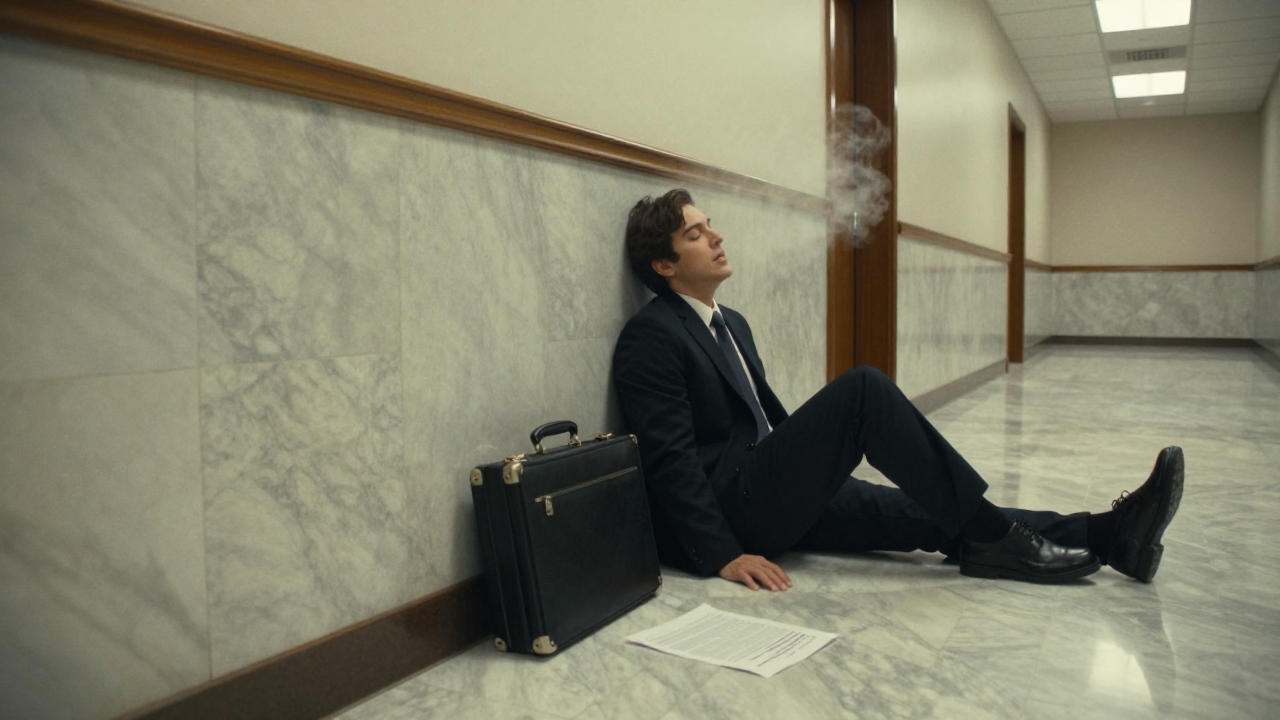
You're standing in the courthouse hallway, and opposing counsel just pulled another obstructive maneuver that will delay everything by weeks. Your jaw clenches. Your chest tightens. Someone-maybe a colleague, maybe a well-meaning friend-once told you to "just breathe" when you get angry.
So you do. You take a few deep breaths. Big inhales, trying to get air into your constricted lungs.
And you're still furious.
Maybe even more furious, because now you're angry and the breathing thing everyone swears by isn't working.
Here's what nobody told you: you've been breathing wrong. Not wrong in some vague, mystical sense-wrong in a specific, technical, measurable way. And that's why it hasn't worked.
WHERE YOU'VE BEEN LOOKING
When someone tells you to "breathe" for anger management, what do you actually do?
Most people take big, quick inhales. They breathe into their chest. They take maybe three or four breaths and expect to feel calmer.
This seems logical. You feel like you can't breathe when you're angry, so you try to get more air in quickly. Your chest feels tight, so that's where you direct the breath. And surely a few good breaths should be enough, right?
The assumption is that any form of "deep breathing" will calm you down. That the simple act of paying attention to your breath-regardless of how you're actually breathing-activates some general relaxation response.
You've been looking at breathing as a binary: either you're doing it (good) or you're not (bad).
But here's what's actually happening when you breathe that way: you're activating the exact physiological system that's already in overdrive.
WHERE YOU SHOULD LOOK
Inhalation activates your sympathetic nervous system-the one responsible for your stress response. That racing heart, those tense muscles, that feeling of being ready to fight? That's sympathetic activation.
Exhalation activates your parasympathetic nervous system-your calming response.
When you take big, quick inhales while angry, you're pouring gasoline on a fire.
Research shows that exhalation increases parasympathetic activity and decreases heart rate, while inhalation does the opposite. A 2024 meta-analysis of over 10,000 participants found that arousal-decreasing activities like deep breathing significantly reduced anger and aggression-but the critical detail is how you breathe.
The real cause of your failed breathing attempts isn't that "breathing doesn't work for you." It's that you're breathing at the wrong speed, emphasizing the wrong part of the breath cycle, and breathing into the wrong location.
Studies demonstrate that slow breathing at approximately 5-6 breaths per minute-one complete cycle every 10-12 seconds-optimally balances the stress response. That's roughly half your normal breathing rate, or even slower.
Your exhale needs to be longer than your inhale. Approximately twice as long. A 1:2 ratio.
And that breath needs to go into your belly, not your chest. Diaphragmatic breathing activates vagal tone and increases heart rate variability (HRV)-an objective, measurable indicator of your emotional regulation capacity.
Think about how you breathe after hot yoga when you're cooling down. Long, slow breaths. Belly rising and falling. That's not coincidental-that's your nervous system naturally downregulating.
The problem with "just breathe" advice is that it skips over every single technical parameter that determines whether breathing will actually work.
WHAT THIS MEANS
You haven't been failing at breathing. You've been following incomplete instructions.
It's like someone telling you to "just win the case" without teaching you trial strategy. The advice isn't wrong-winning is indeed the goal-but it's uselessly vague.
When you understand that inhalation and exhalation activate different branches of your nervous system, everything changes. Suddenly you're not just "breathing"-you're making precise physiological interventions.
Your anger isn't some mysterious force that breathing can't touch. Your anger is a state of high sympathetic arousal, and you now have the specific technical parameters to activate the opposing system.
This means the 4-count inhale, 6-count exhale you've been reading about isn't arbitrary-it's creating a 10-second breath cycle at a 1:1.5 ratio, which falls within the research-validated range of 5-6 breaths per minute.
This means the instruction to breathe into your belly isn't just about "feeling grounded"-it's about mechanically engaging your diaphragm in a way that increases vagal tone.
This means that when clinical trials show techniques like 4-7-8 breathing (inhale for 4, hold for 7, exhale for 8) significantly reduce anxiety and emotional arousal, they're not working through placebo-they're working through measurable changes in heart rate variability and nervous system balance.
You can now evaluate whether breathing is working not by some vague sense of "feeling calmer" but by observing objective indicators: Is your heart rate slowing? Are your muscles releasing? Is your breathing rate actually decreasing?
The reframe is this: breathing for anger isn't about forcing yourself to relax. It's about giving your parasympathetic nervous system the specific signal it needs to naturally counterbalance your sympathetic arousal.
THE CLINCHER
But there's one more element that explains why even people with the correct technique still fail.
You cannot learn a complex skill in the middle of a crisis.
Think about your professional life. You would never attempt a complex legal strategy for the first time in the middle of a trial. You practice until it becomes automatic, and then you deploy it under pressure.
Systematic reviews confirm that effective breathing practice requires minimum 5-minute sessions with regular daily practice. Research shows that effective interventions avoided fast-only breath paces and sessions less than 5 minutes, while including multiple practice sessions and long-term practice.
The technique works-but only if you've trained your nervous system to recognize and respond to the signal.
When you practice slow, diaphragmatic breathing with prolonged exhalation while you're calm, you're essentially teaching your nervous system a new pathway. You're building the neural infrastructure that will be available when you need it.
Practice doesn't just make you "better" at breathing-it makes the physiological response automatic. After consistent practice, your body begins to shift into parasympathetic mode within seconds of initiating the breathing pattern, because you've conditioned that response.
This is why the first attempt in the courthouse hallway didn't work. You were asking your nervous system to execute a complex regulation sequence it had never practiced, while already in a state of high arousal that impairs learning and cognitive function.
The missing element wasn't motivation or effort. It was repetition when the stakes were low.
Start with five minutes daily when you're already calm. Maybe in your car before you enter the courthouse. Maybe right before you pour that glass of wine at the end of the day. Practice the 4-count inhale through your nose into your belly, 6-count exhale through your mouth.
Notice the physical sensations: your hand on your belly rising and falling, the slowing of your heart rate, the release of tension in your shoulders.
After a week or two of daily practice, you'll find that initiating the breathing pattern during actual anger begins to work-not through willpower, but through trained physiological response.
REMEMBER WHEN...
You're standing in that courthouse hallway again. Opposing counsel just pulled the same obstructive maneuver.
Your jaw still clenches. Your chest still tightens.
But now, instead of taking big, quick gasps into your chest, you do something different.
You breathe in slowly through your nose-one, two, three, four-feeling your belly expand.
You breathe out slowly through your mouth-one, two, three, four, five, six-feeling your shoulders drop.
You notice your heart rate beginning to slow. Not because you're forcing calm, but because you've given your parasympathetic nervous system the precise signal it was waiting for.
The situation hasn't changed. Opposing counsel is still obstructive. The delay is still happening.
But you're no longer trapped in the same physiological state.
NOW YOU SEE
What looked like "breathing doesn't work for me" was actually "I was never taught the specific technique."
What felt like failure was actually incomplete information.
The anger is still there-anger is a reasonable response to obstruction and injustice. But now you have agency over whether that anger controls your nervous system or whether you can maintain physiological regulation while experiencing the emotion.
You can see the mechanism now. Inhale activates sympathetic. Exhale activates parasympathetic. Slow the rate to 5-6 breaths per minute. Emphasize the exhale. Breathe into the belly. Practice when calm so it's available when you're not.
Those aren't mystical instructions. Those are technical specifications for a physiological intervention backed by research on thousands of participants.
The same hallway, the same frustrating colleague, the same legal obstruction-but you're equipped with something you didn't have before.
Not positive thinking. Not forced calm. Not "just breathe."
Actual technique.
THE STORY CONTINUES
You now have the foundational breathing parameters: speed, ratio, location, and the practice protocol.
But there's more to discover.
How do you track your progress objectively rather than relying on subjective feeling? What do you do if the 4-6 ratio doesn't feel right for your particular nervous system, and how do you adjust it? How exactly do you transition from calm practice to deploying this technique when you're already in the middle of acute anger?
And beyond breathing, what other interventions work on heart rate variability? What's the research on combining breathing with other parasympathetic activation techniques?
How long does it actually take for this to become automatic enough that you can access it reliably when opposing counsel is at their most infuriating?
You've learned the technique. But technique is just the beginning of mastery.
The courthouse hallway will test you again. And again.
And each time, you'll have one more tool that actually works-not because someone said it should, but because you understand exactly why it does.
What's Next
In our next piece, we'll explore how to apply these insights to your specific situation.


Comments
Leave a Comment