

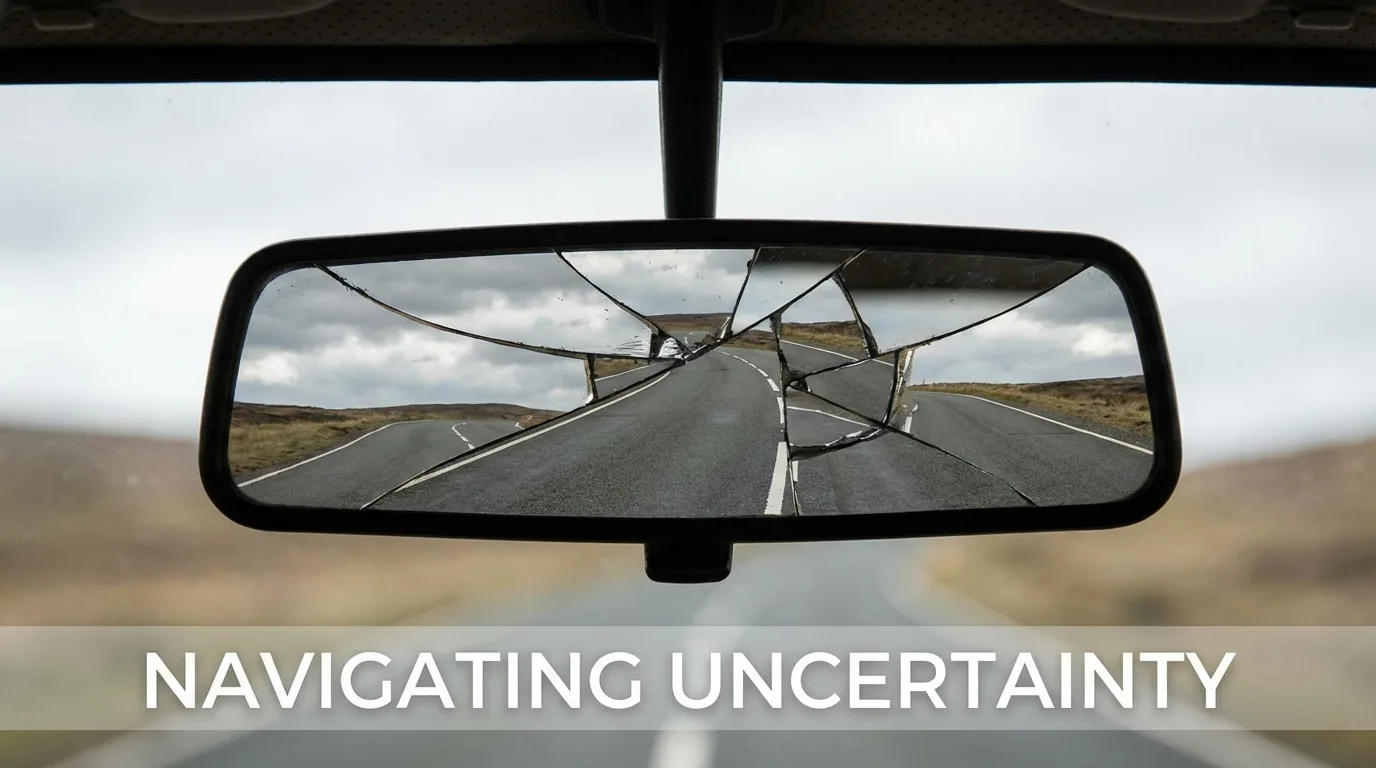
Here's the thing about uncertainty - where it shows up completely changes how it feels.
Ready to Stop When Uncertainty Feels Unbearable? Here's How
You know that feeling when you're learning a new programming language or tackling an unfamiliar project at work? The uncertainty, the not-knowing-if-you'll-figure-it-out sensation? Now compare that to the feeling when you don't know how your relationship will turn out, or whether a major life decision will work out.
Same uncertainty. Completely different experience.
If you're someone who runs through six different contingencies every single day, who started flat-hunting three months early to feel prepared, who maintains "clean exit ideas" even in a committed relationship-you've probably noticed this difference. Work uncertainty feels like a puzzle. Relationship uncertainty feels like a threat.
Here's what most people don't realize: that's not just in your head. Your brain is physically processing these two types of uncertainty through completely different neural pathways.
The Two Uncertainty Systems Your Brain Uses
When you sit down to debug code or analyze an unfamiliar dataset, you're dealing with what neuroscientists call bounded uncertainty. The problem has technical parameters. There's a solution space you can explore. Your brain processes this through the ventral striatum-and here's the surprising part-this can actually feel rewarding. That's why finding a solution path, even before you've solved the problem, brings genuine satisfaction.
But when you wonder whether your relationship will last, or whether you'll lose everything in a marriage, or whether you'll find a solution to whatever life throws at you next-that's unbounded uncertainty. Another person's reactions, life's unpredictability, futures you can't control. This activates your anterior insula and amygdala, the brain's threat detection centers.
You're not experiencing the same thing twice. You're running two fundamentally different neurological programs.
Think about the last time you faced a challenging work problem. Maybe your anxiety spiked initially, but once you identified a solution path-even before actually solving it-something shifted. You felt capable. Focused. The uncertainty was still there, but it felt manageable.
Now think about starting that flat hunt three months early with your girlfriend. Did planning ahead actually reduce your relationship uncertainty? Or did it just give you a concrete task that felt more controllable while the underlying anxiety about the relationship stayed exactly where it was?
The Hidden Problem With Contingency Planning
Here's the pattern: when you face unbounded uncertainty-relationships, life decisions, uncontrollable futures-your instinct is to convert it into bounded uncertainty. Turn it into a technical problem. Create scenarios. Plan contingencies. Research backup approaches.
It's a brilliant strategy. It just doesn't work.
Because here's what you're actually doing: you're not preparing for problems. You're attempting to eliminate the psychological experience of not-knowing.
Every contingency you check, every scenario you run through, every "what if" question you research-these aren't solutions to uncertainty. They're attempts to avoid feeling uncertain. And the problem is, no amount of planning can eliminate unbounded uncertainty. You can't scenario-plan your way out of "I don't know if this relationship will last" or "I don't know if I'll find a solution to the next challenge."
So you keep planning. Checking six contingencies daily. Running through scenarios. And you stay exhausted.
The Truth About Your Fear of Uncertainty
For years, people with high anxiety about uncertainty have believed they're afraid of uncertain outcomes. That the distress comes from not knowing how things will turn out.
But research on intolerance of uncertainty reveals something different: the discomfort isn't about the uncertainty itself-it's about the meta-belief that you can't cope with not-knowing.
Read that again.
You're not actually afraid of uncertain outcomes. You're afraid you won't be able to handle the psychological state of uncertainty before the resolution appears.
That's why you can tolerate uncertainty at work. Not because work problems are less uncertain-they absolutely are uncertain when you start. But because you believe you can handle the process of solving them. The moment you identify a solution path, before you've actually solved anything, the fear drops. What changed? Not the uncertainty. Your belief that you can cope with it.
Your core fear isn't "what if I don't find a solution." It's "what if I can't tolerate not having found the solution yet."
This reframe changes everything.
Why "Just Relax" Never Worked
When people tell you to "just relax" or "stop worrying so much," they're asking you to eliminate the uncertainty response. Make it comfortable. Feel certain.
But that's backwards.
The neuroscience here is clear: your brain can learn that uncertainty doesn't equal threat, but only through experience, not through reasoning. You can't think your way into comfort with uncertainty. You have to practice functioning while uncomfortable.
Small exposures to uncertainty-where you survive the discomfort-gradually retrain those anterior insula responses. Not by making them comfortable. By making them tolerable.
The goal isn't to feel certain. It's to discover you can function while uncertain.
How to Practice Tolerating Incompleteness
Here's what this looks like practically:
Next time you're learning something new at work and that familiar "what if this doesn't work" question appears, don't immediately research three backup approaches. Leave one contingency unchecked.
You'll feel irresponsible. Unprepared. Anxious.
That discomfort is actually information. It's showing you the gap between the actual risk and your perceived risk.
Here's what you're going to discover: the work problem still gets solved. Or the disaster you were preparing for doesn't happen. Or-most importantly-you handle the not-knowing better than you predicted.
That last one is the real experiment. Not whether you succeed at the task, but whether you can cope with uncertainty about the task.
Start small:
- In your work routine: When facing an unfamiliar analysis, identify one "what if" question and deliberately don't answer it. Work on your primary approach while carrying that unresolved contingency.
- In your evening routine: Complete your medication as usual, but vary the order of non-essential steps one night this week. The routine stays complete, but loses its rigid predictability.
- Notice and name: When discomfort arises, acknowledge it without acting on it. "I'm feeling anxious about being unprepared." Then continue anyway.
You're not trying to eliminate the discomfort. You're observing how you function alongside it.
What Happens When You Stop Converting Everything
When you stop trying to convert unbounded uncertainty into bounded problems, something interesting happens:
Relationships can start feeling like being part of a couple, rather than maintaining exit strategies. Not because you've gained certainty about outcomes-you haven't. But because you've stopped requiring certainty as a prerequisite for engagement.
Morning medication and evening routines complete without the compulsive rigidity. Not because they matter less, but because you've practiced tolerating small incompleteness and discovered you survived.
Achievements allow for appreciation rather than immediate jumping to the next level. Not because you've stopped being ambitious, but because you've learned to tolerate the uncertainty of "what if this is as good as I get" long enough to actually feel satisfaction.
The "alarm state" when facing uncertain situations starts including moments of relaxation. Not because the uncertainty disappeared, but because you've built evidence that you can handle not-knowing.
The Question You're Probably Asking
If you're reading this and thinking, "Okay, but how do I know I can trust myself to handle uncertainty if I don't practice contingencies?"-you're asking exactly the right question.
And the answer is uncomfortable: you won't know until you try. That's the point.
You've been running the same experiment over and over-"If I prepare enough, I'll feel certain enough to engage with life"-and it keeps failing. The preparation never creates enough certainty. The alarm never fully quiets.
Time for a different experiment: "What if I engage with life while uncertain, and discover whether I can handle it?"
The only way to change your meta-belief about whether you can cope with not-knowing is to test it. One unchecked contingency at a time.
What We Haven't Talked About Yet
You now understand why work uncertainty feels different from relationship uncertainty. You know that the fear isn't about outcomes but about your belief in your ability to tolerate not-knowing. You have a practice framework for building that tolerance through deliberate incompleteness.
But there's something we haven't addressed: that voice that says "maintaining distance is just being realistic" or "having exit plans is just being smart."
Because here's the thing about attachment security in relationships-it's not actually built on certainty about outcomes. It's builton something entirely different, something that operates independently from the bounded/unbounded uncertainty framework we've been discussing.
And understanding that mechanism changes how you show up in relationships entirely.
But that's a different conversation.
What's Next
Stay tuned for more insights on your journey to wellbeing.




Comments
Leave a Comment