

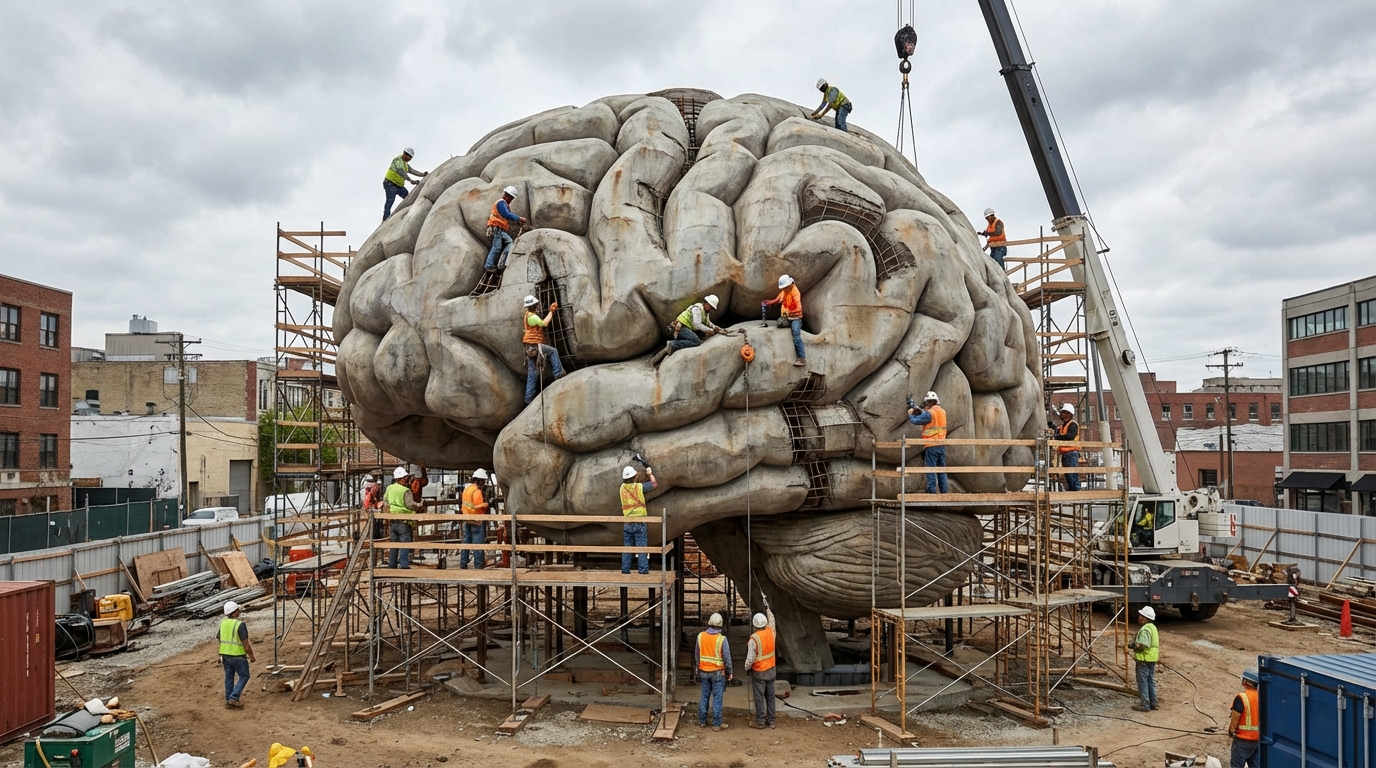
The neuroscience of purpose construction—and why desperation is blocking you
I've spent 27 years helping people recover from trauma. Over 1,600 people have walked through my doors, and one question keeps showing up in different forms:
"What's my purpose? What's my value? Why am I here?"
And I've watched brilliant, capable people spin their wheels for years trying to answer it. The harder they search, the more anxious and depressed they become. The traditional advice—"explore your values," "find your passion," "follow your heart"—leaves them with nothing concrete. Worse, it sends them down a path that actually prevents them from finding what they're looking for.
So I went looking for answers in the one place that cuts through all the philosophical speculation: neuroscience.
What I discovered changed everything about how I help people. Not just in my therapy practice, but in the scalable mental health resources I'm building to help thousands more.
The Discovery That Changes Everything
Here's what most people believe: Your purpose is out there somewhere, waiting for you to discover it. You just need to search hard enough, try enough things, read enough books, and eventually you'll find it.
The neuroscience says something completely different.
Your brain doesn't find purpose. It constructs it.
Your prefrontal cortex builds a purpose framework by integrating three sources of data:
- Past experiences (stored in your hippocampus)
- Emotional reactions (processed by your amygdala)
- Reward predictions (calculated by your ventral striatum)
You're not an archaeologist searching for buried treasure. You're an architect building something new from raw materials.
This reframe isn't just semantics. It completely changes the approach—from searching externally to building internally.
Why Not Knowing Your Purpose Hurts So Much
When clients come to me in crisis about not knowing their purpose, I used to think something was wrong with them. That they needed help fixing this problem.
The neuroscience taught me I had it backwards.
Your anterior cingulate cortex (ACC) is your brain's error-detection system. When there's a mismatch between your prediction model ("I should know my purpose by now") and reality ("I don't know"), it signals that mismatch.
That uncomfortable feeling? That's your ACC working correctly.
Think of it like a check engine light. The light itself isn't the problem—it's signaling something that needs attention. The problem is when that light stays on permanently, creating chronic stress that wears down your entire system.
This is why purpose matters so much for emotional wellness. It's not about having the "right" purpose. It's about having a stable enough framework that your brain can stop running constant error signals.
When you don't have that framework, your brain treats it like a threat. Your anxiety isn't irrational—it's your nervous system doing exactly what it's designed to do when facing chronic uncertainty.
The Trap That Keeps You Stuck
Here's where it gets brutal.
When someone gets desperate about finding their purpose, their brain enters a specific pattern that prevents purpose construction:
- The amygdala activates (detecting existential threat)
- The prefrontal cortex gets inhibited (the part that could actually help)
- The dopamine system shifts from "seeking" to "craving" (like addiction)
- The default mode network runs catastrophic simulations ("I'm 35 and haven't found it yet")
It's like trying to build a house while someone screams "BUILD FASTER! WHY ISN'T IT DONE?!" The screaming itself prevents building.
The paradox is real and neurologically based: You have to stop desperately seeking purpose in order to have the neural capacity to construct purpose.
This explains why people jump from purpose to purpose, self-help book to self-help book, always seeking the next insight. They're not lacking willpower. Their dopamine system has been hijacked.
How Your Brain Actually Builds Purpose
Purpose construction happens in a specific sequence. You can't skip steps. Here's what your brain actually does:
Step 1: Pattern Recognition (Hippocampus)
You do things. Your hippocampus notices what feels rewarding versus aversive. Over time—not immediately, over time—your brain detects recurring themes.
"These categories of experience feel right. These don't."
This is why values-based action works. You're not trying to find the perfect purpose. You're feeding your hippocampus data so it can detect patterns.
Step 2: Narrative Integration (Default Mode Network)
Once you have enough pattern data, your default mode network builds narratives that make sense of it:
"I'm someone who helps people."
"I'm someone who builds things."
"I'm someone who seeks truth."
Notice these aren't specific purposes yet. They're identity frameworks. Your medial prefrontal cortex is creating a self-model that predicts your behavior.
Step 3: Goal Hierarchy Construction (Prefrontal Cortex)
With an identity framework in place, your dorsolateral prefrontal cortex can now build goal hierarchies:
"If I'm someone who helps people, what specific ways make sense for me? Teaching? Therapy? Building tools?"
This is where purpose starts to crystallize. But notice—it's built on top of the identity framework, which itself was built on top of behavioral patterns.
You can't skip steps. You can't think your way to purpose without behavioral data. Your brain literally doesn't work that way.
The Practical Path Forward
Based on this neuroscience, here's what actually works:
Phase 1: Calm Your Nervous System
Before anything else, you need your prefrontal cortex online. That means getting out of threat state.
Daily practices that activate your parasympathetic nervous system:
- Box breathing (4-4-4-4 pattern) or physiological sighs
- Regular sleep, meals, and movement
- Connection with at least one supportive person weekly
This isn't "woo-woo." It's polyvagal theory. When your vagus nerve signals safety to your amygdala, your brain can actually do construction work.
Phase 2: Clarify Your Values
Not your purpose—your values. Values are simpler and more immediate.
Connection. Growth. Contribution. Creativity. Autonomy. Freedom. Justice.
Identify your top 5. For each one, ask: "When have I felt most alive?"
Your brain already knows what matters. You're just making it explicit.
Phase 3: Run Behavioral Experiments
This is where most people get it wrong. They think they need to find their purpose before taking action.
Backwards.
For each of your top values, design one small behavioral experiment per week:
- Value = contribution → Experiment = help a colleague with their project
- Value = growth → Experiment = learn one new skill for 3 hours
- Value = creativity → Experiment = write, draw, or build something small
Keep them small—2 to 4 hours total per week. After each one, track three things:
- Energy level (1-10)
- Sense of rightness (1-10)
- Want to do it again (1-10)
This is your brain giving you data. Your ventral striatum (reward center) and insula (body awareness) are signaling what works.
Don't analyze yet. Just collect data.
Phase 4: Let Patterns Emerge
Every 4 weeks, review your experiment data. Ask: "What themes keep showing up?"
Not what should show up. What does.
Look for:
- Types of activities that consistently energize you
- Types of people you naturally seek out
- Problems you gravitate toward solving
Your hippocampus needs months, not days, to detect patterns. Trust the process.
Phase 5: Test Purpose Hypotheses
Based on the patterns, craft 2-3 purpose statements:
"My purpose is to help trauma survivors build meaningful lives."
"My purpose is to make mental health support accessible to everyone."
These should feel 70% right, not 100%. You're testing, not committing.
Choose one. Live with it for 3 months. Make decisions through that lens.
Track: Does it reduce decision fatigue? Does motivation sustain? Does your anxiety decrease?
Your brain will tell you if the framework works.
What This Means for You
If you've been desperately searching for your purpose and feeling like something's wrong with you, here's what I want you to know:
Nothing is wrong with you.
Your brain is doing exactly what it's supposed to do—signaling that you need a stable framework. The discomfort you feel is functional, not pathological.
The problem isn't that you haven't found your purpose. The problem is that you've been trying to find it instead of building it.
Purpose isn't discovered. It's constructed—step by step, through behavioral experiments that generate pattern data your brain can process.
This takes months, not days. Your hippocampus needs time. Your narrative system needs time. Your prefrontal cortex needs time.
But it works. Not because it's magic. Because it's how your brain actually functions when you create the right conditions.
The path forward isn't more searching. It's creating conditions for your brain to build what you need.
Where to Start Today
If this resonates with you, here's what to do right now:
1. Stop the desperate search. Acknowledge that the searching itself is preventing construction. Give yourself permission to step back from the urgency.
2. Start with your nervous system. Practice box breathing (4 counts in, 4 hold, 4 out, 4 hold) twice daily for one week. Just this. Nothing else.
3. Identify one core value. Just one. Connection, growth, contribution, creativity, autonomy—pick what feels most true. Don't overthink it.
4. Design one tiny experiment. This week, spend 2-3 hours doing something aligned with that value. Track how it feels: energy, rightness, want to repeat.
That's it. Four steps. Start building the data your brain needs.
Final Thought
I've spent 27 years in mental health work. I've seen what works and what doesn't.
What works isn't inspiration. It isn't motivation. It isn't finding your passion.
What works is understanding how your brain actually builds frameworks for meaning, and then creating optimal conditions for that process to unfold.
This is teachable. This is scalable. This works with your brain architecture instead of against it.
The purpose you're looking for? You're going to build it. Starting with one small experiment.
Your brain knows how. You just need to give it the conditions it needs.


.webp)


Comments
Leave a Comment