

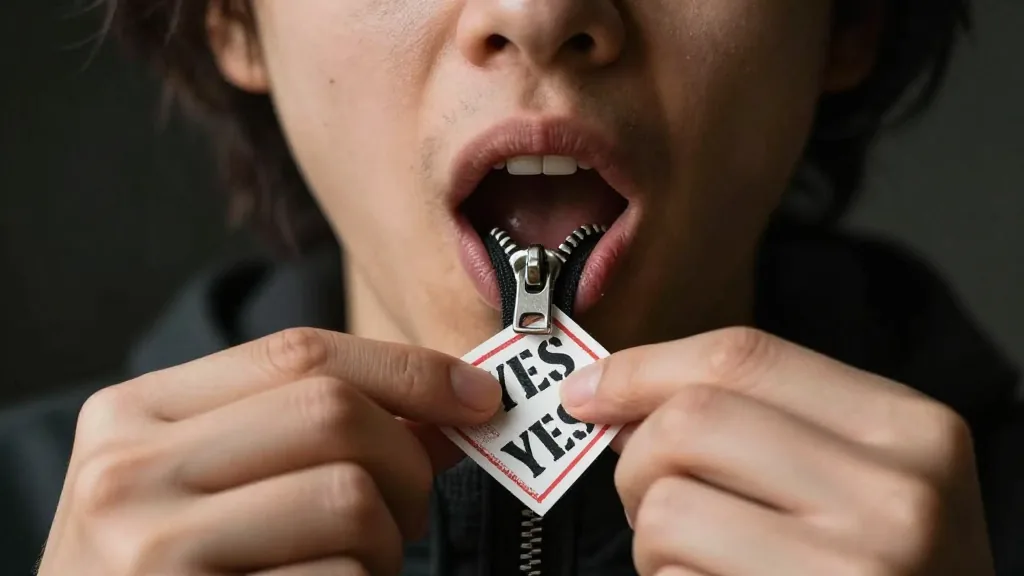
Your phone lights up. It's your brother again. The kids need to be watched-can you take them this afternoon? Your first thought, before anything else, is relief: Thank goodness I can finish what I planned today.
But that relief lasts maybe half a second.
Then the guilt crashes in like a wave. What if they really need me? What if something happens because I wasn't available? What will they think of me? Within moments, you're saying yes again, watching your day dissolve, feeling the familiar knot tighten in your chest.
You wake at 3 AM with racing thoughts. You've stopped the hobbies you loved. You're eating more, sleeping less, and your partner notices you're not yourself. And through it all, one thought repeats: I should be able to handle this. They're family.
What Everyone Gets Wrong About Saying No
Here's what most of us have been taught about saying no:
The problem is you're "too nice." You need to be stronger, more assertive, tougher. Other people can say no without all this drama-why can't you? If you just had more willpower, if you could just stop caring so much what people think, you'd be fine.
The standard advice follows naturally: Practice saying no. Set firmer boundaries. Stop worrying about their reactions. Be more selfish (in a good way). Just do it.
And when that doesn't work-when you either cave to the request or say no but then spend the next three days in an anxiety spiral-the conclusion seems obvious: you're not trying hard enough. You need to want it more. You're letting your weakness control you.
For years, people struggling with boundaries have believed this is a character problem. A deficit of courage or self-respect.
What Your Guilt Is Actually Telling You
But here's what research on family systems and childhood development has revealed:
If you grew up with a critical or emotionally unpredictable caregiver-someone where your worth felt conditional, where nothing you did was quite good enough-your brain built something psychologists call "hypervigilance to social threat."
Your nervous system became exceptionally skilled at detecting even tiny signs of disapproval. Because in your childhood environment, this skill was survival. Keeping the peace, being helpful, anticipating others' needs-these weren't character weaknesses. They were intelligent adaptations to a situation where criticism or rejection had real consequences.
That instinctive thought-What will they think of me?-isn't a character flaw.
It's a protection system that once kept you safe, now working overtime in situations that don't actually threaten your survival.
The proof is in that split-second of relief you felt before the guilt arrived. Your body accurately assessed the situation: you're already overextended, your capacity is full, saying yes will harm your wellbeing. That relief was your internal wisdom speaking.
But then your threat detection system overrides it: Danger. They might disapprove. They might think you're selfish. You might lose their regard.
What you're experiencing isn't weakness. It's a sophisticated alarm system responding to social cues the way it was designed to-based on an environment that no longer exists.
How to Say No Without Fighting Yourself
Here's where everything flips.
The conventional approach says: Override the guilt. Force yourself to say no. Push through the anxiety.
But that approach is backwards.
When you try to muscle through the boundary-setting without addressing the threat detection system, you're fighting your own nervous system. You're treating the anxiety as an obstacle to overcome rather than information to work with.
Research on boundary-setting has revealed something counterintuitive: the people who successfully maintain boundaries aren't the ones who've learned to ignore their feelings. They're the ones who've learned to validate both sides simultaneously.
It's called compassionate assertion.
Instead of choosing between "I honor their needs" OR "I honor my needs," you do both in the same breath:
"I know childcare is challenging and I want to support you. I also need predictability in my schedule to manage my wellbeing. Here's what would work for me..."
You're not overriding the guilt. You're not pretending you don't care about their reaction. You're acknowledging that both things are true: their needs matter AND your capacity has limits.
The method reversal is this: Start with that moment of relief-the body wisdom that knows you're overextended. Trust that signal. Then build your boundary around it, while validating everyone involved.
Don't fight your way to no. Listen your way there.
The One Thing Everyone Overlooks About Boundaries
But here's the element almost everyone overlooks:
The entire conversation about boundaries focuses on whether to say yes or no to requests. Should you help or shouldn't you? Can you handle it or can't you?
But buried in your situation is a critical factor that changes everything.
You mentioned something revealing: when you know about childcare requests in advance, you actually enjoy caring for your niece and nephew. Same children. Same behavioral challenges. Completely different experience.
The forgotten factor isn't your capacity to help. It's the conditions under which your capacity exists.
Advance notice transforms the identical activity from overwhelming to manageable. When you can mentally prepare, adjust your plans, ensure you're rested, maybe do your gardening in the morning before they arrive-your patience expands. The 5-year-old's behavior is still challenging, but you have resources to handle it.
Without notice, when you're ambushed by the request, when your day gets hijacked-the same task becomes unbearable.
This matters because everyone's been asking the wrong question.
The question isn't "Can you care for these children?" The answer to that is obviously yes-you've proven it.
The question is "Can you care for these children under these specific conditions?" And the answer to that is no. Not sustainably. Not without abandoning your own wellbeing.
What most advice on boundary-setting completely misses: Your boundaries don't have to be about the activity itself. They can be about the conditions that make the activity sustainable.
You don't have to stop helping. You have to stop helping on terms that disregard your need for structure and preparation.
What Happens If You Keep Saying Yes
Imagine the path if nothing changes.
You continue the current pattern. Your brother and sister-in-law keep dropping the children off without notice. You keep saying yes while feeling resentful. The 3 AM wake-ups continue. The polytunnel sits unused. The overeating persists as your only stress relief.
But here's what research on unclear boundaries predicts:
The resentment doesn't stay contained. You start avoiding their calls. When you see their car pull up, anger flares instead of warmth. You're physically present with the children but emotionally checked out, probably shorter-tempered than you want to be because you're running on empty.
Eventually, one of two things happens: either you explode-all that suppressed resentment erupting in a way that damages the relationship far more than an honest conversation would have-or you quietly distance yourself, creating the very rejection you were trying to avoid.
The self-fulfilling prophecy completes itself: in trying desperately to avoid being seen as selfish or unhelpful, you become the overwhelmed, irritable person you feared being judged as. Your attempts to prevent criticism create the exact conditions for it.
And through it all, you still haven't learned to trust that initial moment of relief-the body wisdom that knew from the beginning this wasn't sustainable.
What Changes When You Set Real Boundaries
Now imagine a different path.
You draft a message with your husband's help. Not a confrontation-a design for how this can actually work:
"I love spending time with the kids and want to keep being part of their lives. I've realized I need more structure to show up as my best self for them. I'm available for childcare on Tuesdays and Thursdays with 24-hour notice. For unexpected needs, you'll need a backup plan."
You send it. The anticipatory anxiety is real-your threat detection system is doing its job. But you notice something: once you take action, the 3 AM rumination starts to ease. Anticipatory anxiety decreases when we move toward the thing we're avoiding, not away from it.
Maybe they respond well. Maybe they're resistant. But here's what you control: your boundary. Not their reaction to it.
When they show up unannounced (because they might test this), you enforce it: "Today doesn't work for me. Let's look at the calendar for a scheduled day." Your husband stands beside you. You're not doing this alone.
And something unexpected happens: on those Tuesday and Thursday afternoons, when you've had time to prepare, when you've already done your gardening in the morning, when you're rested and mentally ready-you're good with the kids. Patient. Present. The version of yourself you actually want to be.
The relationship improves rather than deteriorates. Because clear boundaries don't damage relationships. Unclear boundaries that breed hidden resentment do.
You start sleeping better. The stress eating lessens. You're back in your polytunnel, hands in soil, reconnected to something that nourishes you.
And critically: you've learned to trust that moment of relief. The body wisdom that signals when you're overextended. You don't override it anymore. You listen.
The One Thing You Can Do Today
You don't have to have the whole conversation today.
You don't have to enforce a boundary you haven't set yet.
You don't have to figure out every scenario or prepare for every possible reaction.
Here's the single step that separates these two paths:
Write the draft.
Not the final message-just the draft. Sit down with your husband and write out what would actually work for you. The specific days. The advance notice requirement. The acknowledgment that you care AND that you have limits.
Get it out of your head and onto paper.
Because here's what happens when you do: that swirl of anxiety becomes concrete words. The overwhelming "I can never say no" becomes a specific, reasonable request. The thing you've been avoiding becomes something you can see, edit, refine.
You might not send it this week. That's fine.
But writing it is the act that says: My relief matters. My body's wisdom about my capacity deserves respect. I can honor both my desire to help and my need for sustainable conditions.
That's not selfishness.
That's the first move toward a life where you're not constantly choosing between your wellbeing and your relationships-where you've learned the surprising truth that protecting one actually protects both.
What's Next
Stay tuned for more insights on your journey to wellbeing.





Comments
Leave a Comment