

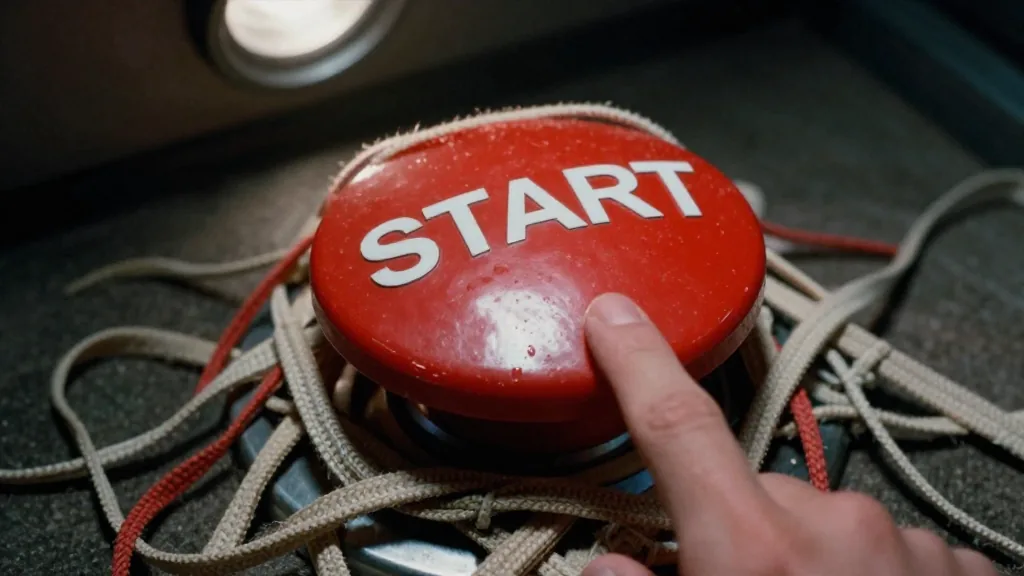
You know the feeling. The assignment is due in three days. You should start. You need to start. You open your laptop, stare at the blank document, and feel... nothing. Not anxiety. Not determination. Just a flat, heavy sense of "I can't be bothered."
So you close the laptop. You'll feel more like it tomorrow.
Tomorrow arrives. Same laptop. Same blank document. Same absence of feeling. The voice in your head is almost automatic now: "I can do it later." And somewhere underneath that: "It doesn't really matter anyway."
If this has been your reality for months-if you've spent more than a year watching yourself not do the things you know you should do-you've probably concluded something about yourself. Something about willpower. About character. About what kind of person you are.
Here's what you haven't concluded: that your brain is lying to you about what happens next.
The Motivation Mistake Making It Worse
When you can't start, the standard advice follows a clear logic:
1. Find your motivation
2. Get inspired
3. Want it badly enough
4. Then you'll be able to act
This makes perfect sense. After all, when you do feel motivated, action becomes easy. So obviously, the solution to not acting is to manufacture that feeling first.
There's just one problem: if you're depressed, your brain has lost the ability to generate that feeling on command. Waiting for motivation to arrive before you act is like waiting for your broken leg to heal before you use the crutches.
You end up in a trap. You can't act because you don't feel motivated. You can't feel motivated because you haven't acted. And every day you don't act, you collect more evidence that you're the kind of person who doesn't act.
What Your Brain Gets Wrong About Effort
Here's what's actually happening in your brain:
When you think about doing something-going to the library, starting an assignment, attending a lecture-your brain makes a prediction. It estimates how much effort the task will require and how you'll feel afterward.
This prediction system is designed to help you make decisions. Do this thing? Or do something else?
But depression breaks the prediction system in a specific way.
Research on motivational forecasting shows that when you're depressed, your brain systematically underestimates how good you'll feel after completing an activity. It also overestimates how much effort the activity will require.
So when you think about going to the library, your brain calculates: "This will be exhausting and I'll still feel terrible afterward. Why bother?"
The critical part: this prediction is wrong.
Your brain isn't reporting reality. It's running faulty software. And because the prediction feels like truth-because you genuinely can't imagine feeling better after studying for an hour-you trust it.
Why Waiting for Motivation Fails
Here's what actually happens when someone breaks out of severe procrastination:
They don't wait to feel motivated. They act before they feel like it. Then-and only then-the feeling changes.
This sounds wrong. It sounds like "just force yourself," which you've already tried and failed at a hundred times.
But there's a crucial difference.
Forcing yourself means using willpower to overcome resistance. It means fighting your brain's faulty predictions with sheer determination.
What works is different: you remove the need for willpower entirely by removing decisions.
The Three-Day Test
This is the smallest possible test. It's designed to create a direct measurement of the gap between what your brain predicts and what actually happens.
Setup (do this tonight):
- Pack your bag with everything you need for 45 minutes of work
- Set an alarm for the same time tomorrow
- Choose a specific seat in the library (same seat every day)
Day 1:
- Before you go, rate 0-10: "How do I think I'll feel after 45 minutes at the library?"
- When the alarm goes off, go to the library
- Sit in your seat for exactly 45 minutes (set a timer)
- Work on anything. If you stare at the wall for 45 minutes, that counts
- When 45 minutes ends, rate 0-10: "How do I actually feel right now?"
- Leave immediately
- Write down both numbers
Day 2 and 3:
- Repeat exactly
What you're measuring:
- The prediction gap (what you thought vs. what happened)
- Whether the gap changes across three days
- Whether going to the same seat at the same time for the same duration feels different than "trying to study"
How Structure Works Without Willpower
Notice what this experiment removes:
Decisions eliminated:
- Whether to go (alarm decides)
- When to go (same time decides)
- Where to sit (same seat decides)
- How long to stay (timer decides)
- Whether you worked hard enough (45 minutes is the only criterion)
Every decision you have to make costs cognitive resources. When you're depressed, you have fewer resources available. Decision fatigue doesn't just make you tired-it actively amplifies depressive symptoms.
The conventional approach to procrastination adds decisions: "I should study more. I should try harder. I should care about this."
This approach removes them. You're not deciding whether to be motivated. You're testing whether your brain's predictions are accurate.
The scaffolding principle:
External structure-predetermined time, place, duration-isn't a sign that you're weak. It's recognition that depression creates a specific cognitive impairment.
You wouldn't tell someone with a broken leg that using crutches proves they lack determination. The crutches are the appropriate tool for the impairment.
When your brain can't generate accurate predictions about reward, external structure is the appropriate tool. It's not temporary. It's not something you'll graduate beyond once you're "strong enough." It's how the brain rebuilds the connection between action and positive outcomes.
The Library Secret Nobody Mentions
Something else happens at the library that matters:
You see people. The same librarian. Students who sit in nearby seats. The person at the coffee cart.
These aren't friendships. You might never learn their names. But repeated casual contact with the same people does something specific: it creates what researchers call "weak social ties."
Weak ties don't require emotional intimacy. They don't require vulnerability or deep conversation. They just require presence.
And presence-being in a space where other humans exist and recognize your existence-reduces the cognitive burden of isolation.
When you're socially isolated, your brain has to work harder to process social information. It's looking for threats. It's hypervigilant. Even if you don't consciously feel anxious, the background cognitive load increases.
Weak ties tell your brain: "You're not isolated. These people exist in your regular environment. You don't have to be on high alert."
This is why studying alone in your room-even if it's quieter, even if there are fewer distractions-often feels harder than studying in a library. You're missing the cognitive relief that casual human presence provides.
What Happens on Day Three
If you complete all three days, here's what tends to happen:
Day 1 usually confirms your brain's prediction. You predicted you'd feel terrible, and you might. The gap between prediction and reality is small.
Day 2, something shifts. Not always motivation. Sometimes it's just... slightly less resistance. Going to the same seat at the same time requires fewer decisions than Day 1.
Day 3 is where the pattern becomes visible. The prediction gap often widens. You still predict it will be awful, but when you check after 45 minutes, you notice: it wasn't as bad as you thought. Maybe not good. But not as bad.
That gap-between the prediction and the reality-is the crack in the system.
It's the first evidence that your brain's forecasting system is giving you bad information.
Why This Isn't Forcing Yourself
The reason this works has nothing to do with strength of character.
You're not "forcing yourself" to be motivated. You're creating the conditions where your brain can update its predictions based on actual data instead of depressive forecasting errors.
Behavioral activation-the therapeutic approach this experiment comes from-treats depression as a problem of disconnection between action and reward. When you stop doing things, you stop experiencing positive outcomes. When you stop experiencing positive outcomes, your brain's prediction system gets trained on absence.
The solution isn't to feel better first. It's to act in a way that generates data, then let your brain slowly recalibrate.
What Comes Next
Three days at the library won't cure depression. It won't make you love your Economics degree or solve 15 months of procrastination overnight.
But it will do one specific thing: it will show you that the voice saying "I can't be bothered" and "It doesn't matter" isn't reporting facts. It's running a prediction model with corrupted data.
Once you see that-once you have your own measured evidence that what you predicted and what happened are different-you have something to work with.
The automatic thoughts don't go away immediately. "I can't be bothered" will still appear. But now you know: that's a prediction, not a fact. And predictions can be tested.
The deeper work-understanding where those automatic thoughts come from, what core beliefs they're protecting, why your mind reaches for "it doesn't matter" as a shield-that's the next layer.
But you can't do that work while you're still trusting your brain's faulty forecasts about what action will cost and what it will return.
First: test the predictions.
Then: examine what's underneath them.





Comments
Leave a Comment