

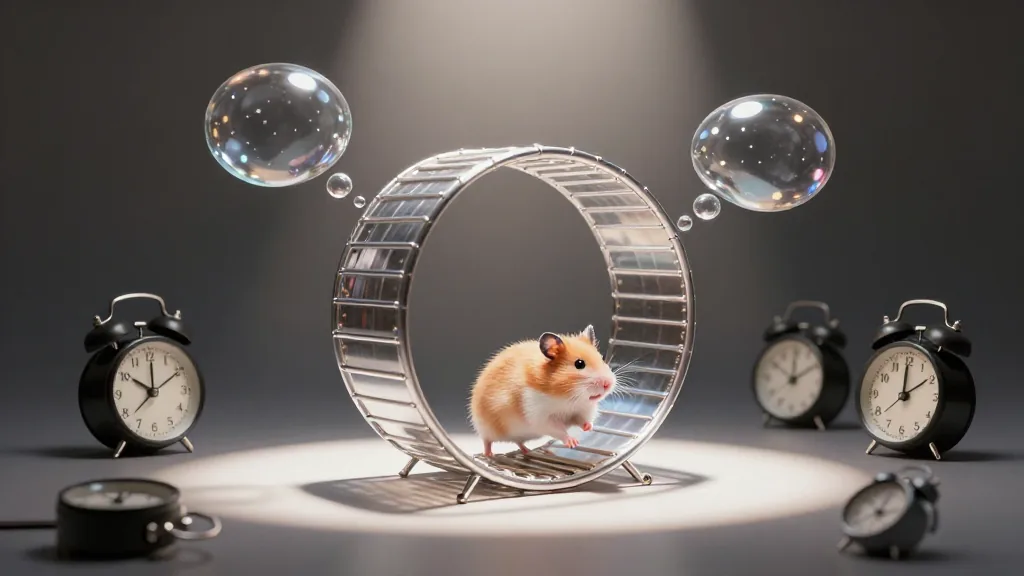
Your mother mentions she's feeling tired. Within seconds, your brain has already constructed a complete narrative: she has a serious illness. You're imagining doctor visits, treatments, outcomes. Then the thought shifts to your daughter-what if something happens to you while she's still young? What about her education? What if your wife gets sick too? And the work deadline you're already behind on...
By the time you surface from this spiral, you're exhausted. Your heart is racing. And you're frustrated with yourself for the same reason you've been frustrated for years: Why can't I just stop worrying?
If you've asked yourself that question, you've probably also tried to answer it with willpower. You've told yourself to calm down, to think positively, to focus on what you can control. You might have built strict routines that help you feel safer-until any deviation from the schedule sends you spiraling again.
And when none of it works, the conclusion feels obvious: there's something wrong with you. You're weak. You lack discipline. You're overthinking because you can't help yourself.
But what if I told you that's not the problem at all?
What Nobody Tells You About Why You Worry
When most people experience recurring worry cycles-the kind where your thoughts follow the same sequence and always end with feeling overwhelmed-they blame their inability to control their mind. It feels like a personal failing, a character flaw that separates you from people who seem to navigate uncertainty with ease.
This belief makes sense. After all, if the problem is that you can't control your worry, then the solution should be... more control. More discipline. Stronger willpower. Tighter routines that eliminate unpredictability.
But here's the issue: if lack of control were really the problem, your routines would have solved it by now. If it were about willpower, your years of effort would have worked. If it were a character flaw, you'd see this same pattern across every area of your life-but you don't. You're successful at work. You manage complex projects. You maintain relationships.
So why does this particular kind of worry persist?
The Worry Secret Nobody Talks About
In most cases of generalized anxiety and excessive worry, the actual cause isn't weakness or lack of control. It's something called intolerance of uncertainty-and it's not a character flaw. It's a learned response.
Here's what that means: At some point, usually during childhood, your brain created an equation. Something uncertain happened-something where you couldn't predict or control the outcome-and the result was devastating. Maybe it was a sudden loss, like a sibling who died without warning. Maybe it was a parent's illness, a family crisis, something that shattered your sense of safety.
Your brain, doing exactly what it's designed to do, formed an association: Uncertainty = Danger.
This wasn't a conscious choice. It was your nervous system's way of trying to protect you. If uncertainty leads to disaster, then the logical solution is to eliminate uncertainty wherever possible. Predict everything. Control everything. And when you can't? Worry about it. Because worry feels like you're doing something.
Research on childhood trauma and anxiety shows this pattern clearly: adverse experiences during formative years create distorted cognitions about uncertainty. The brain becomes wired to perceive ambiguous situations as threatening. And this association doesn't just fade with time-it can persist for seven years or more, continuing to shape how you respond to uncertainty as an adult.
Why This One Insight Changes Everything
Once you understand that your worry isn't a personal failing but a learned response, everything shifts.
You're not weak. You're not broken. Your brain isn't malfunctioning-it's actually doing exactly what it was trained to do during a critical period of development. The problem isn't that you worry; it's that your brain is still running a program that was written during trauma.
Think about it this way: If you asked a child whose sibling just died, "Will your parents die too?" and the adults in their life can't give a definite "no," what does that child's brain learn? It learns that uncertainty-that feeling of "I don't know what will happen"-is terrifying. It learns to scan constantly for threats. It learns that the only way to feel safe is to eliminate uncertainty entirely.
Years later, when your wife mentions she's tired, your brain doesn't hear a simple statement of fact. It hears an uncertain variable-and uncertainty triggers the old alarm. Your brain jumps to the worst possible outcome because that's what it was programmed to do: treat uncertainty as a predictor of disaster.
This is why trying to "calm down" or "think positively" doesn't work. You're not addressing the underlying program. You're just trying to override it with willpower-and willpower can't compete with a response that was wired in during childhood trauma.
The Treatment That Works
Here's where the research gets interesting.
A meta-analysis of 26 studies involving nearly 1,200 people with generalized anxiety disorder found something remarkable: when therapy specifically targets intolerance of uncertainty-rather than just teaching general anxiety management-the results are significantly better.
People who received cognitive behavioral therapy designed to change their beliefs about uncertainty showed large improvements both immediately after treatment (effect size of 0.88) and at follow-up (effect size of 1.05). Even more striking: the effects got stronger over time, not weaker.
Why?
Because when you target the root cause-your brain's association between uncertainty and disaster-you're not just managing symptoms. You're building new neural pathways. You're teaching your brain a different equation.
In fact, research shows that reductions in intolerance of uncertainty account for 59% of the reduction in worry during treatment. It's not just correlated with improvement-it's the mechanism that drives it.
Two Shifts That Make This Work
Shift #1: Why Uncertainty Doesn't Mean Disaster
The first shift is recognizing that the equation your brain learned-uncertainty equals disaster-is a generalization from a specific traumatic event, not a universal truth.
Yes, sometimes uncertain situations lead to painful outcomes. But sometimes they lead to neutral outcomes. And sometimes they lead to positive ones.
When you met your wife, that was uncertain. When you got the job offer that became your career, that was uncertain. Some of the best things in your life came from situations where you didn't know what would happen.
This isn't about forcing yourself to "think positive." It's about collecting evidence that challenges the automatic equation. It's about asking, when your brain screams "uncertainty = disaster," whether that's actually true in this specific case.
Research in positive psychology shows that reframing uncertainty as potential opportunity rather than automatic threat enhances creativity, problem-solving, and resilience. The goal isn't to eliminate uncertainty-that's impossible. The goal is to change your relationship with it.
Shift #2: Why Worry Doesn't Help
The second shift is recognizing the difference between worry and productive problem-solving.
Here's a question: What would it mean about you as a parent if you worried less about your daughter's education but still helped her with homework every night? What would it mean about you as a son if you stopped catastrophizing about your mother's health but still called her regularly?
The actions aren't dependent on the worry. The worry just creates the illusion of control. It makes you feel like you're doing something responsible when you're actually just exhausting yourself.
Many people with anxiety hold positive beliefs about worry: that it helps them prepare, that it shows they care, that it somehow prevents bad outcomes. But worry doesn't prevent anything. It just loops through the same scenarios without taking action.
Productive problem-solving asks: "Is there a concrete action I can take right now?" If yes, you take it. If no, you're in the territory of uncertainty-and that's where the practice of tolerance comes in.
Start These Three Practices Tonight
Understanding the mechanism is powerful, but the real change comes from practice. Here's what research suggests actually works:
Create an Uncertainty Log
Get a notebook or create a document with four columns:
- The uncertain situation
- Your initial prediction (what your brain said would happen)
- What actually happened
- An alternative neutral or positive interpretation
Every evening, spend 15 minutes reviewing uncertain situations from your day. Start small-minor things like an ambiguous email from a colleague, a small schedule change, the grocery store being out of your preferred item. You're building evidence against the automatic "uncertainty = disaster" equation.
The key is consistency. Make this part of your routine-use your natural preference for structure as an asset rather than viewing it only as rigidity.
Use the Two-Question Protocol
When you notice yourself starting a worry cycle, pause and ask:
- "What's the uncertainty I'm trying to eliminate here?"
- "Is there a concrete action I can take right now?"
If yes, take the action. If no, practice tolerance by generating one neutral or positive way this uncertainty could resolve. You're not trying to convince yourself everything will be fine-you're just challenging the automatic assumption that it will be a disaster.
Separate Worry from Action
Write down the concrete caregiving actions you already take: calling your mother weekly, reviewing your daughter's homework, showing up for your wife. Look at that list. Those are the things that demonstrate care and responsibility.
Now notice: none of those actions require the mental torture of catastrophizing. You can do all of them while practicing uncertainty tolerance. The worry isn't helping-it's just making you believe it is.
What Becomes Possible
Here's what the research shows happens when people practice cognitive restructuring specifically targeting uncertainty beliefs:
Their brain builds new pathways. The old "uncertainty = disaster" program doesn't disappear overnight, but it gradually gets replaced by a more flexible response. And because this addresses the root mechanism rather than just symptoms, the improvements strengthen over time.
People report that situations which used to trigger immediate catastrophizing start to feel more manageable. The recurring thought cycles-mother's health to daughter to wife to work-don't have the same grip. There's space between the uncertain trigger and the overwhelming conclusion.
Life becomes less rigid. Social events don't feel threatening because they disrupt the routine. Changes at work don't spiral into disaster scenarios. The need for control loosens-not because you've forced it to, but because uncertainty itself feels less dangerous.
None of this means anxiety disappears completely. But it means you develop a different relationship with it. You recognize the old program running, and you have tools to respond differently.
What You're Not Being Told
There's something else here-something that most standard anxiety treatment overlooks.
You've learned that intolerance of uncertainty is the primary driver of your worry cycles. You've started building evidence against the "uncertainty = disaster" equation. You're practicing the two-question protocol and tracking outcomes in your uncertainty log.
But research identifies three secondary processes that link intolerance of uncertainty to excessive worry: positive beliefs about worry (which we've touched on), negative problem orientation, and cognitive avoidance.
You show signs of both of the latter two. When you encounter situations with multiple variables-your mother's health, your daughter's education, work deadlines all swirling together-you tend to view these as overwhelming threats rather than challenges to address one at a time. And your reliance on routines, while providing comfort, may also function as a way to avoid uncertain situations entirely.
These patterns interact with your intolerance of uncertainty to maintain the worry cycles. Understanding them-and learning specific techniques to shift from threat perception to challenge appraisal when problems arise-represents the next layer.
But that's a conversation for another time.
For now, start with what you know: Your worry isn't a character flaw. It's a learned response. And what was learned can be updated-one uncertain situation at a time.
What's Next
Stay tuned for more insights on your journey to wellbeing.





Comments
Leave a Comment