

Opening
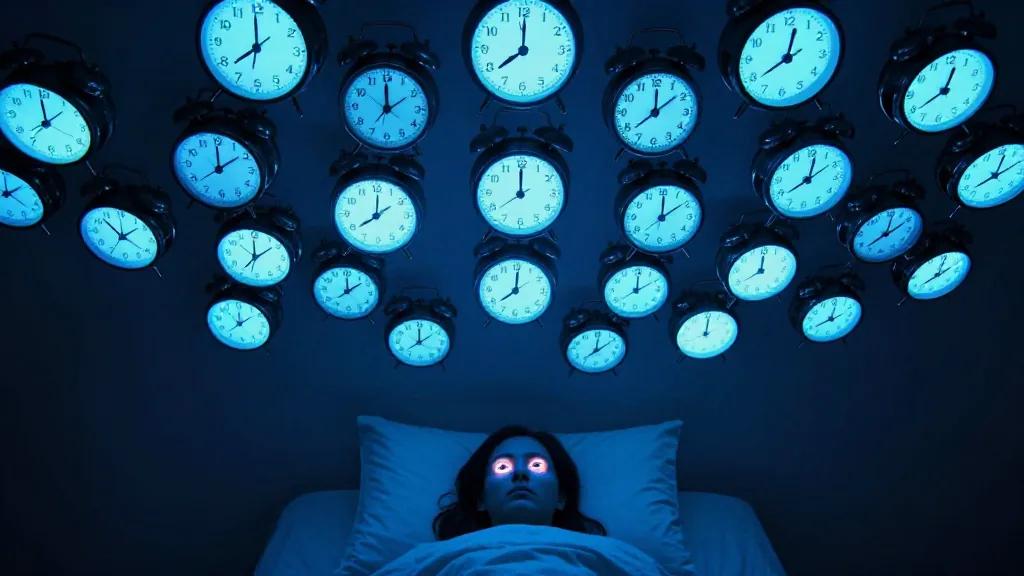
It's 3am and you're staring at the ceiling again.
Your shift at the hospital ended six hours ago, but your brain won't stop replaying the day. You know what tomorrow will be like-heavier, darker, harder to get through. The exhaustion makes everything worse. Your depression feeds on the sleeplessness, and the sleeplessness feeds on the depression.
You've tried white noise apps. You've tried leaving the TV on until your eyes finally close. You've tried driving around until you're too exhausted to stay awake. Nothing works for long.
And underneath it all, the question that keeps you stuck: Which problem do I fix first?
If the depression is causing the insomnia, shouldn't you wait until you're less depressed before trying to fix your sleep? But how can you get less depressed when you're running on three hours of broken sleep every night?
You're trapped in a loop with no entry point. No way to break in.
Where You've Been Looking
When you can't sleep and you're depressed, the assumption seems obvious: the depression is the real problem. The insomnia is just a symptom.
It makes sense. Depression came first, didn't it? The sleeplessness followed. So treating the depression should fix the sleep problem. That's what most people believe. That's probably what you've believed.
Every article you've read, every conversation with your doctor-they all seem to point in the same direction. Fix the depression. The sleep will follow.
So you're waiting. Maybe for the right antidepressant to kick in. Maybe for therapy to work its way through your patterns. Maybe for your life circumstances to shift enough that the depression lifts.
In the meantime, you're coping. The TV, the driving, the white noise-they're not solutions, you know that. They're just ways to survive the night. Ways to fill the dark hours until your body gives up and lets you sleep.
But here's what's strange: if depression really is the root cause and insomnia is just the symptom, why do you remember that period last year when you switched to day shifts and your sleep improved-and suddenly your mood lifted too? Why does a single terrible night of sleep make the next day not just more tired, but genuinely more hopeless?
If insomnia were simply downstream from depression, you wouldn't expect it to have its own independent effects.
Where You Should Look
What if I told you that the question itself-"Which came first, the depression or the insomnia?"-is the wrong question?
Research on depression and insomnia has revealed something that changes everything: the relationship is bidirectional. Not "one causes the other." Not "one is a symptom of the other." Both conditions genuinely cause and worsen each other in a reinforcing loop.
The majority of people with depression experience clinically significant insomnia, with rates rising as depression becomes more severe. For decades, medicine viewed those sleep problems as an epiphenomenon-a side effect of depression. But longitudinal studies have revealed something different: insomnia isn't downstream from depression. It's a predictive early warning sign that often appears before full depression develops.
People with insomnia are ten times more likely to develop depression than the general population. And when you have both conditions simultaneously, each one actively worsens the other through multiple biological pathways-HPA axis dysfunction, inflammatory activation, neurotransmitter disruption.
Here's what this means: when you lie awake at night, your insomnia isn't just reflecting your depression. It's fueling it. The sleep deprivation is changing your brain chemistry, increasing inflammation, dysregulating stress hormones. Your depression isn't causing all of that-your lack of sleep is an independent contributor.
And here's the part that opens the door: psychological and behavioral patterns develop that keep the insomnia going independent of what initially caused it.
Think about what happens when you can't sleep. You start watching TV in bed. You lie awake for hours feeling anxious. You start to dread going to bed because you associate it with frustration and failure. Your brain is learning, night after night, that bed is not a place where sleep happens. It's a place where you lie awake feeling terrible.
Those associations, those patterns-they're not depression. They're insomnia maintaining itself through conditioning. And that means something crucial: you don't have to wait for the depression to lift before you address them.
What This Means
This changes the entire game.
You've been stuck because you thought you had to solve the depression first. You thought treating insomnia while still depressed would be like bailing out a boat while water is still pouring in-pointless until you plug the leak.
But if both conditions are maintaining the cycle, if both are legitimate independent problems rather than one being merely a symptom of the other, then breaking in at either point can begin to unravel the whole pattern.
You don't need to cure your depression before you can address your insomnia. Treating the sleep problem directly isn't avoiding the "real" issue-it's attacking one of the two engines driving the cycle.
And here's where it gets even more interesting: when you treat insomnia directly using evidence-based approaches, you don't just improve sleep. You improve depression symptoms too.
A systematic review analyzing multiple clinical trials found that people receiving treatment specifically for their insomnia showed a 32% response rate for depression symptoms, compared to just 17% for control groups. The sleep treatment had measurable effects on depression-not because it "cured" the underlying mood disorder, but because it removed one of the major factors constantly destabilizing mood, energy, and emotional regulation.
When you finally get consistent sleep, your brain has the resources to regulate emotions better. The exhaustion that weighs down every single moment lifts. The inflammatory processes quiet down. The stress hormones start to normalize. You're not just more rested-you're giving your brain the conditions it needs to function.
That "stuck" feeling you've been living with-the sense that there's no entry point to the cycle-it came from a false assumption. The assumption that you had to pick the "real" problem and fix it first. But you don't. You can walk through the door marked "insomnia" and find that it leads somewhere.
The Clincher
So if treating insomnia can provide an entry point, what does that treatment actually look like?
Most people with insomnia do exactly what you've been doing: try to force sleep to happen. White noise to distract the mind. TV until you pass out. Driving around until you're too exhausted to stay awake. These approaches all try to override or outlast the problem.
But there's an evidence-based intervention that almost no one knows about, and it works completely differently.
It's called CBT-I (Cognitive Behavioral Therapy for Insomnia), and it's recommended as the first-line treatment for chronic insomnia by every major sleep medicine organization. Not medications. Not supplements. CBT-I.
Here's what makes it different: it doesn't try to force sleep or mask the problem. It retrains your brain's associations and rebuilds your biological sleep drive.
Remember how we talked about your brain learning that bed equals wakefulness and anxiety? CBT-I systematically reverses that conditioning using stimulus control-you rebuild the association between bed and actual sleep. No more lying awake for hours. No more TV in bed. The goal is simple: bed becomes paired with sleep again, not with frustration.
The second component is sleep restriction therapy, which sounds counterintuitive but works by rebuilding your sleep drive. By initially limiting your time in bed (not your sleep, your time trying to sleep), you create genuine sleepiness that makes falling asleep easier. You're working with your body's biology, not against it.
Here's what the research shows: CBT-I produces results equivalent to sleep medication, but with no side effects, fewer relapses, and a tendency for sleep to continue improving long after treatment ends. People using CBT-I see an average reduction of 19 minutes in how long it takes to fall asleep, and 26 minutes less time awake during the night.
And here's the part that matters for your situation: CBT-I has a moderate effect on alleviating depressive symptoms even though it's not designed to treat depression. By breaking the insomnia part of the cycle, you remove one of the things constantly feeding the depression.
You're not ignoring the depression by treating the insomnia. You're targeting both problems through the one that has the clearest, most evidence-based intervention available.
This isn't about positive thinking your way to sleep. It's not meditation or breathing exercises. It's a systematic behavioral approach that addresses the specific patterns keeping you awake. And it works whether you do it with a specialized therapist or through a digital program-the effectiveness is comparable.
Remember When...
Think back to that moment at 3am, staring at the ceiling.
The question that kept you paralyzed: Which problem do I fix first?
The feeling of being trapped in a cycle with no entry point, no way to break in. The exhaustion making everything heavier. The depression feeding on the sleeplessness. The certainty that you'd have to somehow fix your depression before you could hope to sleep normally again.
The resignation in all those temporary solutions-the TV, the driving, the white noise. They weren't really solutions at all. They were just ways to survive until morning. Ways to cope with a problem you thought you couldn't address directly.
Now You See
What was invisible is now visible.
The insomnia wasn't something you had to endure while waiting for your depression to lift. It was never just a symptom sitting downstream from the "real" problem. It was an independent engine driving the cycle-and therefore a door you could actually walk through.
The same sleepless night at 3am, but the meaning has changed. You're not stuck anymore. You don't have to wait for some future version of yourself who's less depressed before you can begin to address the sleep. The sleep itself is a legitimate target. A place to start.
Those patterns your brain learned-that bed means wakefulness, that night means anxiety-they're not permanent. They're conditioned responses. And what's been conditioned can be reconditioned.
When you thought you had to cure depression first, you had no clear path forward. Antidepressants help some people but not everyone. Therapy is valuable but slow. Your life circumstances might not change soon. You were waiting for something uncertain and distant.
But CBT-I is concrete. It's systematic. It has clear protocols and strong evidence. You can find a specialist. You can access a digital program. You can start retraining those associations now, not someday when you're "better."
And here's what you couldn't see before: by addressing the sleep, you're also addressing the depression. Not instead of other treatments-alongside them. Every night you sleep better is a night your brain can recover, regulate, stabilize. Every improvement in sleep is fuel away from the depression, not just the insomnia.
You're not choosing between treating sleep or treating depression. You're choosing to break into the cycle at the point where the intervention is clearest and most effective.
The Story Continues
You understand now that insomnia is a legitimate entry point, not a distraction from the "real" problem. You know that CBT-I exists and that it's the evidence-based first-line treatment. You can see why your previous approaches-the TV, the white noise, the exhausted late-night drives-weren't addressing the underlying pattern.
But you're probably wondering: what do those concrete techniques actually look like day-to-day? How exactly does stimulus control work when you're lying in bed at 2am? What does sleep restriction therapy involve, and how do you implement it safely when you already feel like you're barely functioning? How do you find a qualified CBT-I provider versus just a general therapist? Can a digital program really work as well as in-person therapy?
And here's the tricky part specific to your situation: how do you adapt these protocols when you're working irregular nursing shifts that already disrupt your circadian rhythm? Can the techniques be modified for shift workers, or does the night schedule make this impossible?
The door is open now. But there's still more inside to discover.
Because understanding that you can break the cycle is different from knowing how to break it. The next step isn't just knowing CBT-I exists-it's learning to use the specific tools that will rebuild your relationship with sleep.
And that's where the real work begins.
What's Next
In our next piece, we'll explore how to apply these insights to your specific situation.





Comments
Leave a Comment