

Trapped in Cycles? Your Brain Can Learn New Patterns
Look at the list. Sleep has been a disaster for years. Work keeps falling apart—you start strong, then things pile up until everything collapses. The friendships that used to sustain you have dwindled to almost nothing. The creative activities that once gave you energy feel like distant memories. Most days, you're just trying to survive.
And when you look at all of this together, the math seems impossible. That's not one thing to fix. That's everything. That's you. To change all of this, you'd need to become an entirely different person.
But what if that math is wrong?
The Truth About Your List of Problems
When you see sleep problems, work struggles, social withdrawal, and lost creativity as separate issues, you're looking at a repair job that would take years and require changing your fundamental identity. No wonder it feels hopeless.
But let me ask you something: When you don't sleep well, what happens to your focus the next day at work?
The answer is obvious—it's terrible. You can't concentrate. Simple tasks take forever. You make mistakes you have to fix later.
And when you're making mistakes at work and things are piling up, what happens to your stress level?
Through the roof. You're constantly on edge. You spend energy just trying to look like everything's fine, which makes you even more exhausted.
And when you're that stressed and exhausted, what happens when you try to sleep that night?
It's worse. Your mind races. You lie there thinking about everything you messed up and everything you need to do tomorrow.
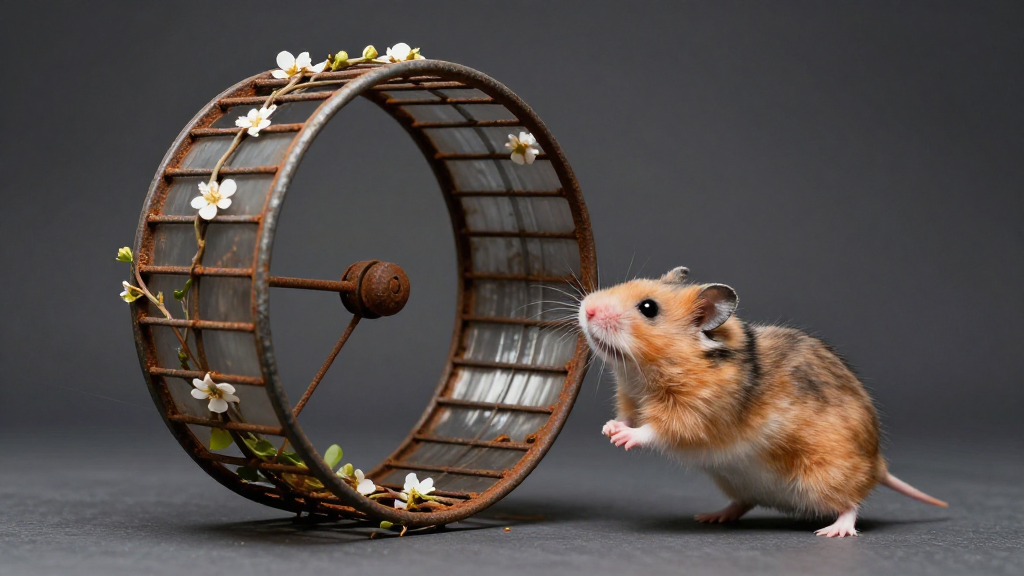
Do you see what just happened? We didn't discuss three separate problems. We traced one circle.
3 Loops That Keep You Stuck
What looks like a list of separate failures is actually three interconnected loops, each feeding the others:
Loop One: The Stress-Sleep Spiral
Poor sleep impairs your cognitive function—research shows it directly damages attention, working memory, and decision-making. The impaired performance creates stress. The stress elevates cortisol, which makes sleep worse. The worse sleep further impairs cognition. Round and round.
Loop Two: The Avoidance-Overwhelm Trap
When you feel distressed, avoiding problems provides immediate relief. But the avoided tasks pile up. The bigger pile creates more distress. More distress drives more avoidance. Eventually something collapses and you're scrambling to survive. This isn't a character flaw—research shows procrastination functions as a temporary emotional band-aid that reduces discomfort now but increases psychological burden later.
Loop Three: The Criticism-Paralysis Cycle
When you're exhausted, stressed, and things are falling apart, a voice starts running: I'm failing. Nothing's going to work. Everyone else can handle life and I can't. That voice doesn't give you energy to tackle problems—it drains what little energy you have left. Less energy means worse performance. Worse performance means louder criticism. Studies on self-criticism confirm this creates a measurable downward spiral through repetitive negative thinking.
Here's what changes everything: these three loops don't just coexist. They feed each other.
Bad sleep triggers the stress-sleep spiral. The stress triggers avoidance. The avoidance triggers criticism. The criticism steals energy needed for sleep. Each loop spins up the others.
This is why every job starts strong then collapses. At first, the loops aren't running yet. You have reserves. Then stress starts the first loop. It cascades to the second. Then the third. Within months, all three are spinning together, and it feels like everything is falling apart—because everything is interconnected.
You don't have fifteen problems requiring fifteen fixes. You have one system with three interlocking parts.
The 'I Can't Change' Trap
But here's where it gets really interesting.
Even if you accept that these are loops rather than a list, you might still believe that your patterns are permanent. That stress responses, avoidance, and self-criticism are just who you are. That you're wired this way, and at 31, people don't just radically change.
Let me challenge that.
Have you ever learned a skill that felt impossible at first but eventually became automatic? Typing, maybe? Driving? Playing an instrument?
Think about learning piano—specifically, the first time you tried to play something with both hands. Complete disaster. Your hands wouldn't do different things. You'd focus on one hand and the other would stop or start mirroring it. It felt like your brain simply wasn't built for this.
But eventually, you could do it. What changed?
Practice. Repetition. Eventually it just happened without thinking.
What you experienced was your brain physically reorganizing itself. New neural pathways formed through repetition. The connections supporting independent hand movement literally grew stronger until the skill became automatic.
This isn't a metaphor. Your brain reorganizes and modifies its connections in response to experience and learning—not just in childhood, but throughout your entire life. Research confirms that adult neuroplasticity remains active, though it operates differently than childhood plasticity.
Why Your Patterns Aren't Who You Are
The stress responses, the avoidance, the self-criticism—they feel like who you are because you've practiced them for years. What happens when you practice something thousands of times?
It becomes automatic. Like muscle memory.
Your brain has been running these loops—the stress response, the avoidance, the self-criticism—over and over for years. Of course they feel like identity. They're deeply grooved neural pathways.
But here's what that actually means: they're not who you are. They're patterns you've trained.
And your brain has the same capacity to train different patterns that it used to learn piano.
There's even a specific mechanism that drives this. A protein called BDNF strengthens the neural connections you use and helps new connections form. Research shows that physical movement and adequate sleep increase BDNF—while chronic stress decreases it.
This means the loops aren't just making you feel bad. They're actively suppressing the very mechanism that would help you build new patterns. Stress literally makes your brain less capable of change.
But the reverse is equally true. When you interrupt even one loop—when you get a bit more sleep, reduce stress a bit, move your body—you're not just feeling better. You're physically increasing your brain's capacity to change.
Why Change Never Seems to Stick
If this is true, why have things gotten better before only to slide back?
Think about the piano again. When you were learning, did you expect to play perfectly after a few weeks? Did you conclude you were incapable of learning after hitting wrong notes?
No. You expected it to take months. Bad practice sessions were just part of the process.
But when you try to change these patterns and have a setback, you treat it as proof you can't change. Not as a bad practice day—as confirmation of permanent inability.
And that interpretation is itself the self-criticism loop running. The pattern protects itself by reframing normal practice failures as identity confirmation.
Once you see this, a different approach becomes possible.
How to Start Interrupting the Loops
First: Interrupt any loop, and you take pressure off the others.
You don't have to fix everything simultaneously. The loops are connected, which seems like bad news but is actually the best news. Slowing down even one loop reduces the fuel feeding the others and creates conditions for your brain to build new pathways.
Second: Treat setbacks like bad practice sessions.
Not proof of inability. Not confirmation that you're fundamentally broken. Just a day where you hit some wrong notes. Part of the process.
Third: Start with the most accessible loop.
Which loop could you make one small change to? Not the hardest one—the one where you could imagine a single realistic intervention.
For many people, the criticism loop is most accessible. When you catch yourself thinking "nothing will work," you don't have to argue with it or make it stop. Just notice: there's the loop running.
That recognition alone is different from the pattern. It's a new neural pathway, however small. Do that enough, and the recognition becomes automatic. You're training your brain to observe the loop instead of just being in it.
From 'Broken' to 'Practicing'
The shift isn't from "broken" to "fixed." It's from "I need to become an entirely new person" to "I need to practice different patterns until they become automatic."
That's still hard. But it's piano hard, not impossible hard.
And you've done piano hard before.
One question this raises: if sleep sits at the center of all three loops—affecting both performance and the brain's physical capacity to change—what actually makes the brain struggle to wind down at night? And how can you work with that wiring instead of against it?
That's worth understanding. Because if you can interrupt the sleep loop, you might find the other two start losing their grip.
What's Next
What are the specific mechanisms behind why the brain struggles to wind down at night, and how can someone work with that wiring instead of against it?



Comments
Leave a Comment