

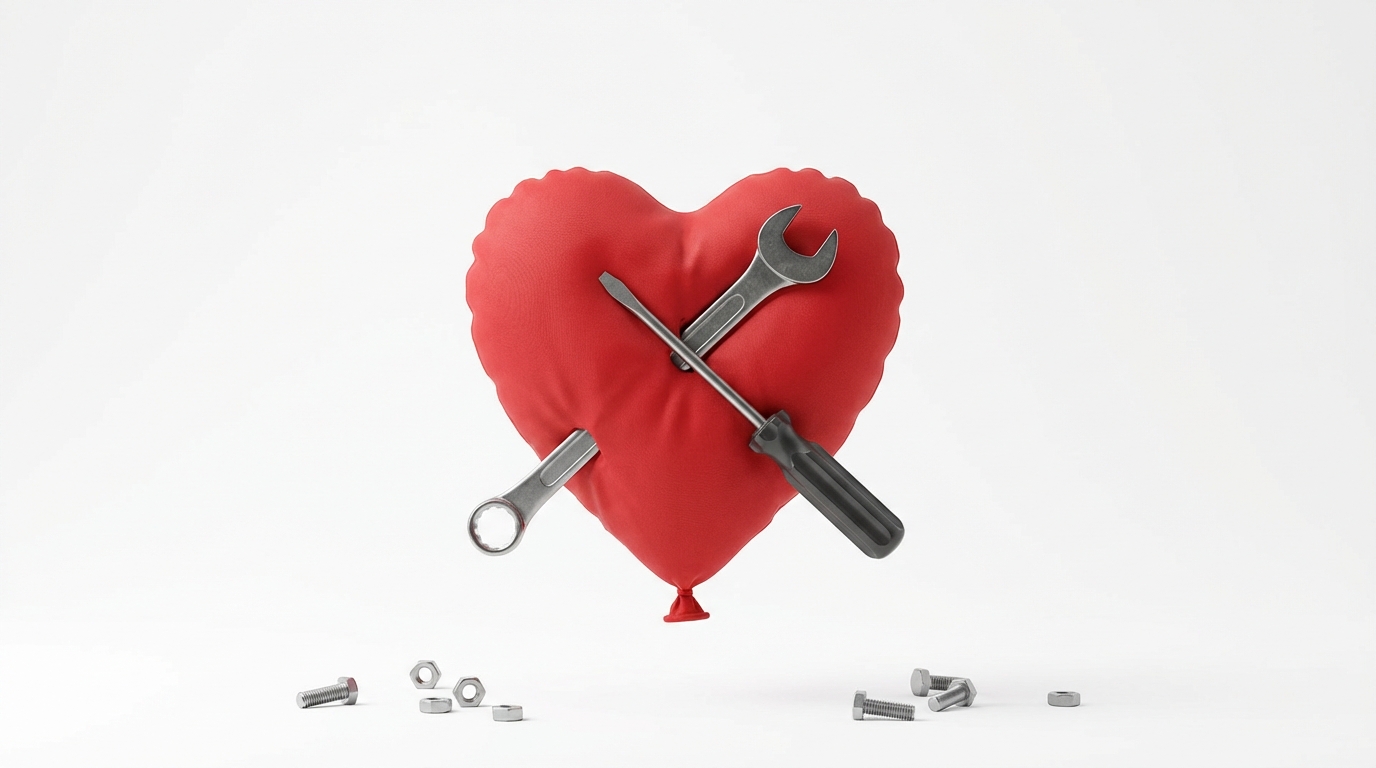
By the end of this page, you will have one move that stops the snowball before it builds — so the next hard feeling stays one hard feeling, not a week of abandoned workouts, restless nights, and 'why can't I handle this.'
You're good at solving problems. Maybe that's what you do for a living—quality improvement, engineering, operations. Or maybe you're just the person everyone calls when something breaks.
Your brain has been trained to respond a certain way: Notice the problem. Analyze the cause. Implement the fix. Move on.
It works. It works so well that when anxiety or grief or frustration shows up, your brain does exactly what it knows how to do. You run a root cause analysis on yourself. What's causing this? How do I fix it? What steps do I need to take to make this feeling go away?
But something strange happens when you apply this approach to your emotions.
The feeling doesn't go away. And your brain draws a conclusion: I haven't found the right fix yet. Something's wrong with me because I can't solve this like I solve everything else.
Sound familiar?
Why Your Best Skill Fails You With Emotions
In quality improvement, when you find the root cause of a defect, you implement the fix. You eliminate the defect. The problem goes away.
That's because you're working with controllable variables. There's a process you can modify. A setting you can adjust. A cause you can address.
But here's a question that might shift something for you:
What's the process variable you can modify to eliminate grief over losing someone you love? What setting do you adjust to stop fearing for your husband's health?
There isn't one.
You can't bring someone back. You can't guarantee a loved one's health. You can't fix these situations the way you fix a manufacturing defect.
And yet your brain keeps trying to run the same analysis. Which means every time the emotion doesn't go away, you log another failure. The self-criticism kicks in. What's wrong with me? Why can't I handle this?
This is when the snowball starts rolling. One area feels like a failure, so you think—what's the point of exercising, eating well, sleeping well, if I can't even manage my own feelings? And everything collapses.
The same approach that made you excellent at your job is now making you feel like a failure at life.
The Truth About Trying to Fix Your Emotions
Here's something research has uncovered that contradicts everything your problem-solving brain believes:
Trying to "fix" an emotion makes it stronger and last longer.
That's not how problems work. With problems, more effort usually equals better results. But emotions aren't problems.
Think of it this way. When you're scrubbing a stubborn stain on a pan, more pressure and more scrubbing often works. But what if you applied that same force to cleaning a delicate antique dish?
You'd crack it. Or scratch it beyond repair.
Emotions are more like the antique dish. They don't respond to force. And the harder you scrub—the more you analyze, strategize, and try to solve—the more damage you do.
Research on what's called experiential avoidance shows that trying to control or escape uncomfortable internal experiences paradoxically intensifies psychological distress. The very effort to make the feeling go away is what keeps it around.
Your Emotions Are Signals, Not Defects
Here's the paradigm shift that changes everything:
Your emotions aren't problems to be solved. They're signals about what matters to you.
Grief isn't a malfunction in your system. It's the natural response of a person who loved deeply. Fear about your husband's health isn't a defect to eliminate—it's proof that you care profoundly about him.
These emotions aren't telling you something is wrong with you. They're telling you something is important to you.
When you treat feelings like manufacturing defects—running root cause analysis, trying to implement fixes—you're using the wrong tool entirely. It's like trying to tighten a screw with a hammer. Not only does it not work, it makes things worse.
The Simple Technique That Actually Calms Emotions
Here's where it gets counterintuitive.
Researchers discovered something almost too simple to believe: simply naming what you're feeling—just putting the emotion into words—actually reduces its intensity.
Not analyzing it. Not fixing it. Not strategizing about it.
Just naming it.
"This is grief." "I'm feeling anxious." "This is frustration."
That's it. No action plan required.
Brain imaging studies show that when you label an emotion, something shifts automatically. The thinking part of your brain comes online while the emotional alarm center calms down. This happens without any effort on your part. People don't even feel like they're regulating their emotions when they do this—but the change shows up clearly on brain scans.
Your problem-solving brain might resist this. That seems too passive. I'm not doing anything.
But you are doing something. You're giving your brain the cue it needs to shift out of alarm mode. You're just not doing it the way you're used to doing things.
Why Old Grief Comes Flooding Back
If you've ever "dealt with" grief by staying busy—handling the funeral arrangements, going back to work, keeping moving—this might explain something.
Research on grief shows that when we avoid the painful feelings through activity and distraction, the grief doesn't actually go anywhere. It waits. And when a new stressor comes along—something that taxes your emotional capacity, like a loved one's health crisis—the old grief can emerge all at once.
That feeling of "losing your mind" when everything hit at once? That wasn't you breaking. That was your system finally processing what had been put on hold.
This is normal. Not a sign that you're broken. A sign that your capacity was overwhelmed and the feelings that had been waiting finally had space to emerge.
The Trap of Trying to Fix Your Fixing
Here's something to watch for. As you read this, you might notice your brain is already doing it:
Okay, so I need to practice labeling emotions. I need to stop problem-solving. I need to be more like my husband who just accepts things. How do I implement this?
You're trying to fix your fixing.
That awareness—noticing when you slip into fix-it mode—is actually the most important skill. Because your problem-solving ability isn't the enemy. It's a strength. You just need to recognize when to apply it and when to set it aside.
This isn't about getting rid of who you are. It's about having more options.
How to Respond to Emotions Without Fixing Them
The next time you feel an emotion rising—anxiety, grief, frustration—try this:
Step 1: Pause before analyzing.
Notice the urge to figure out what's causing this and how to fix it. Don't follow that urge.
Step 2: Name it.
"This is grief." "I'm feeling anxious." "This is fear." Use plain words. Be specific if you can, but simple labels work.
Step 3: Stop there.
Don't add "and I need to fix it." Don't follow the label with an action plan. Let the label sit there by itself.
Step 4: Observe.
Notice what happens to the emotion after you name it. Don't try to make it change. Just watch.
This will feel strange. Your brain has decades of practice jumping into solution mode. The strangeness you feel is actually a good sign—it means you're doing something different.
What Emotionally Steady People Do Differently
You might already have an example of what this looks like.
If you have someone in your life with a more accepting, steadier way of handling difficulty—someone who acknowledges "this is hard" and then keeps going without spiraling into fixing mode—you're seeing this approach in action.
They're not taking things less seriously. They're not being passive. They're labeling the difficulty and then not treating it like a defect that needs elimination.
You might have thought they just didn't care as much. But what they're actually doing is matching their response to the situation. When something is uncontrollable, they respond with acknowledgment rather than analysis.
That's the flexibility you're building.
What Changes When You Stop Fixing Feelings
When you stop treating emotions like problems to solve, several things shift:
The pass/fail test disappears. You're no longer evaluating yourself on whether you "fixed" the feeling. The emotion is just information, not a verdict on your competence.
The snowball effect loses its power. When you're not failing at fixing your emotions, you don't have a reason to abandon everything else. You can feel anxious and still go for a walk. You can feel grief and still eat a decent meal.
The exhaustion decreases. Fighting emotions takes enormous energy. Acknowledging them takes almost none.
The Next Question: What About the Mask?
There's another layer to this that you've touched on: the mask.
Maintaining a "happy-go-lucky" appearance when you're struggling internally is its own form of emotional labor. It's a different kind of suppression—not trying to eliminate the feeling, but hiding that it exists.
What happens when we express emotions to others versus hiding them? Is there a middle ground between performing happiness and falling apart?
That's a different question than the one we've addressed here. But it builds on the same foundation: emotions aren't problems. They're information. And what you do with that information—including whether and how you share it—matters.
For now, start with the simpler skill. Name it. Don't fix it. See what happens.
The feelings you've been fighting so hard to solve might just need to be seen.
What's Next
What happens when we express emotions to others versus suppress them—and is there a middle ground between wearing a 'happy-go-lucky' mask and falling apart?





Comments
Leave a Comment