

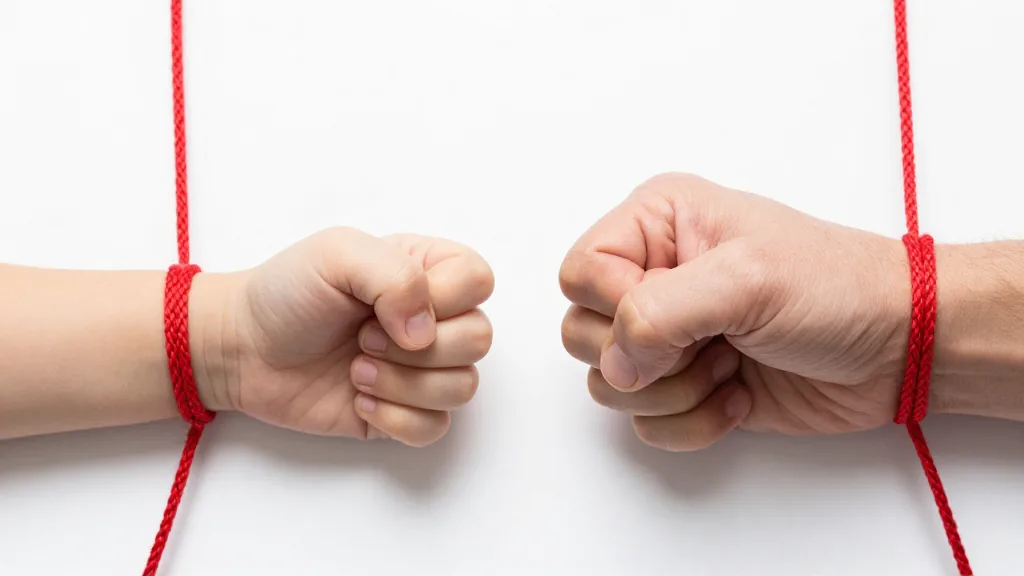
Three generations of the same temper.
You sit there afterward, heart pounding, thinking: This is genetic. This is inevitable. I can't stop what's in his DNA.
WHERE YOU'VE BEEN LOOKING
When you watch your son detonate over a toy, when you see him mirror your father's explosions, when you notice the same short fuse burning through three generations-you've been searching for answers in one place: genetics.
It makes sense, doesn't it? Your father had it. You have it. Now your son shows the same pattern. The evidence seems overwhelming. Anger must be coded into your family's DNA, passed down like eye color or height. You've been looking at chromosomes, at inherited traits, at biological inevitability.
Most people facing multi-generational behavior patterns make this same assumption. When the same temperament appears across three generations, the genetic explanation feels undeniable. Research even confirms that 20-60% of the variation in temperament traits like emotional reactivity is heritable.
So you've been watching your son's outbursts as proof of genetic destiny. Counting each explosion as confirmation that intervention is futile. Wondering if all the parenting books and emotional coaching strategies are just fighting biology. Fearing that no matter what you do, the anger gene will win.
You've been staring directly at DNA, convinced that's where the answer lives.
WHERE YOU SHOULD LOOK
But here's what you haven't been counting: three generations with the same anger pattern, yes-but also three generations who received zero emotional coaching.
Your father exploded, then acted like nothing happened. Nobody talked about it. When you got angry as a child, you were sent to your room. Alone. Silent. No one taught you to name the feeling, no one offered strategies, no one helped you understand what was happening in your body.
The same absence, repeated. Generation after generation.
Now ask yourself this: If three generations struggled with anger AND three generations received no emotional regulation skills, which factor is actually being inherited?
Neuroscience research reveals something surprising: the brain's emotional regulation circuits-particularly the prefrontal cortex connections to the amygdala-develop based on experience. When children repeatedly practice regulation strategies with supportive adults, they literally build stronger neural pathways for managing intense emotions. These pathways don't exist automatically. They're constructed through thousands of interactions.
Your father didn't build them. You didn't receive the scaffolding to build yours fully. And without intervention, your son won't build them either.
The pattern you're witnessing isn't just genetic transmission. It's the transmission of absence. The absence of skills is being passed down just as powerfully as any DNA sequence. Three generations of genetic predisposition, yes-but also three generations of environmental void.
What you should be looking at isn't just chromosomes. It's what didn't happen in the moments after the explosions. It's the empty space where emotional coaching should have been. It's the silence that followed the rage.
That void? That's what's truly hereditary in your family.
WHAT THIS MEANS
This changes everything about what you think you're fighting.
You've been operating under the paradigm that your family carries "anger genes"-a genetic curse that codes for rage and short fuses. Under that paradigm, intervention feels like swimming against a biological current. You're fighting DNA itself. The best you can hope for is damage control.
But the research points to a different paradigm entirely: What if your family doesn't carry "anger genes" at all? What if you carry "intensity genes"?
Here's the distinction that matters: Some children are born with more reactive nervous systems. They feel everything more strongly. That intensity is partly heritable-the 20-60% genetic component. But intensity itself is neutral. It's a temperament trait, not a destiny.
That same intensity that manifests as anger when there's no emotional support? It becomes passion, determination, and strong advocacy when there IS support. The genetic predisposition isn't toward rage specifically-it's toward feeling things powerfully.
Think about what this means: Your father had intensity without tools. You have intensity with incomplete tools. Your son has intensity, but for the first time in three generations, he's receiving something different.
You mentioned that after his outbursts, you stay calm when possible. You ask him what he was feeling. You talk about what he could do differently next time. You practice taking deep breaths together.
Your father never did that for you. No one in your lineage did that.
That's not fighting a genetic curse. That's building neural infrastructure that never existed before. That's filling the void that created the pattern.
The paradigm shift is this: You're not powerless against genetic inevitability. You're powerful in creating environmental intervention. The anger pattern wasn't inevitable-it was the predictable result of intensity meeting absence. You're no longer perpetuating the absence.
Your son isn't doomed by his DNA. He's experiencing, for the first time in your family's history, what happens when intensity meets skill-building.
THE CLINCHER
But here's the element almost everyone misses when working to break intergenerational patterns: You're measuring the wrong thing.
You're counting outbursts. When your son still explodes over the puzzle pieces, you interpret that as failure. As evidence that intervention isn't working. As proof that the genetic component is winning.
Every parenting book and support group has taught you to track behavior frequency. Fewer tantrums equals progress. Continued tantrums equal failure. That's the standard metric.
But that metric completely misses how neural pathways actually develop in a five-year-old brain.
Your son's prefrontal cortex-the brain region responsible for impulse control and emotional regulation-won't be fully developed until his mid-twenties. At age five, expecting him not to have outbursts is like expecting him to run a marathon when his leg bones haven't finished growing. The outbursts aren't evidence of failure. They're evidence of age-appropriate neurodevelopment.
The forgotten factor that reveals actual progress isn't outburst frequency. It's what happens during and after the intensity strikes.
The markers that matter:
Recovery speed: How quickly does he calm down after exploding? Is the storm shorter than it was six months ago?
Emotional vocabulary: Can he use any words to describe his feelings during or after? Does he say "frustrated" or "mad" instead of just screaming?
Self-awareness moments: Does he ever catch himself before the full explosion? Even once?
Empathy afterward: Does he show understanding or remorse after he's calm?
These indicators reveal neural pathway development, even when outbursts continue. They're measuring the invisible infrastructure being built inside his brain.
You mentioned that last week, your son stopped himself mid-yell and said "I'm really frustrated." That moment-that single moment of self-awareness-represents his prefrontal cortex interrupting the amygdala's automatic response. That's evidence of exactly the neural rewiring that breaks intergenerational patterns.
That never happened for you or your father, did it?
You also said he seems to calm down faster than he used to. That's recovery speed improving. That's regulation capacity strengthening.
These are the metrics that reveal whether you're breaking the pattern. And by these measures-the ones that actually matter-you're succeeding. Dramatically.
But you've been staring at outburst frequency, which is the wrong target entirely for a five-year-old. You've been measuring the thing that can't change yet, while missing all the evidence of the things that are changing.
The forgotten factor is this: Progress in emotional regulation looks like improved recovery and awareness, not eliminated reactivity. Especially in early childhood. The intensity will still trigger. The difference is what happens in the seconds and minutes afterward.
That's what you're changing. That's where the pattern breaks.
REMEMBER WHEN...
Your son can't complete the puzzle. The pieces won't fit. His jaw clenches. His face reddens. The explosion comes.
But now watch what happens next.
You stay present. Your voice stays calm. You don't send him away. You don't rage back. You don't pretend it didn't happen.
Twenty minutes later, when he's calm, you sit together. "What were you feeling when the puzzle wouldn't work?" you ask.
"Frustrated," he says. "Really, really frustrated."
"Yeah," you tell him. "Puzzles can be frustrating. Your body got really big feelings. What could we try next time when frustration gets that big?"
You practice some breaths together. You talk about maybe asking for help. You acknowledge that it's hard.
Then you move on. Together.
NOW YOU SEE
The scene looks the same on the surface. Your son still exploded. The anger still appeared.
But everything invisible is different.
Where your father saw rage as unmentionable, you're naming feelings. Where you received silence, your son receives vocabulary. Where previous generations built no neural pathways for regulation, your son is constructing them one interaction at a time.
The pattern isn't broken yet. The intensity is still there. But the infrastructure that transforms intensity into something workable-that's being built for the first time in three generations.
You're not fighting genetic destiny. You're filling an environmental void that made genetic predisposition look like destiny.
The explosions will continue for years, probably. That's normal childhood development. But each time you stay calm during his storm, your nervous system helps regulate his. Each time you help him name the feeling, you're adding words to his internal library. Each time you talk about alternative responses, you're building mental pathways he can access next time.
Your father didn't have that library. You had to build yours as an adult, which is why it's incomplete. Your son is building his from age five.
Thirty years from now, when he has his own children, the infrastructure will be there. Fully formed. Ready to pass down.
That's not fighting a curse. That's ending one.
THE STORY CONTINUES
You've discovered that what looked like genetic inevitability was actually genetic predisposition meeting generational absence. You've learned that intensity isn't damage-it's a trait that needs channeling. You've found out that progress lives in recovery speed and awareness, not in eliminated outbursts.
But here's what remains: You're still struggling with your own anger responses. You mentioned you don't always succeed. Sometimes you yell. Sometimes the intensity takes over.
And when it does, you feel like you're proving the genetic curse exists. Like you're demonstrating that the pattern can't actually be broken. Like all your work with your son is undermined by your own struggles.
But is it?
What happens in those moments when you lose your calm? What do you do after you yell?
You apologize. You name your mistake. You tell your son that even adults are learning to handle big feelings better.
That repair work-that's teaching something your father never taught you. That change is possible. That mistakes aren't permanent. That emotional regulation is a lifelong practice, not a fixed trait you either have or don't have.
Which raises a question: If the pattern-breaking isn't about eliminating your own intensity, but about modeling growth and repair... what else about your assumptions needs to shift?
What becomes possible when you stop measuring yourself against perfection and start measuring yourself against your father's silence?
The story of breaking intergenerational patterns isn't over. It's only beginning. And the next chapter involves something you haven't fully explored yet: What it looks like when you extend the same grace to yourself that you're learning to extend to your son.
What's Next
In our next piece, we'll explore how to apply these insights to your specific situation.
References
- Saudino, K. J. (2005). Behavioral genetics and child temperament. Journal of Developmental and Behavioral Pediatrics, 26(3), 214-223. https://doi.org/10.1097/00004703-200506000-00010
- Wager, T. D., Davidson, M. L., Hughes, B. L., Lindquist, M. A., & Ochsner, K. N. (2008). Prefrontal-subcortical pathways mediating successful emotion regulation. Neuron, 59(6), 1037-1050. https://doi.org/10.1016/j.neuron.2008.09.006
- Zwir, I., Arnedo, J., Del-Val, C., Pulkki-Råback, L., Konte, B., Yang, S. S., ... & Cloninger, C. R. (2020). Uncovering the complex genetics of human temperament. Molecular Psychiatry, 25(10), 2275-2294. https://doi.org/10.1038/s41380-018-0264-5




Comments
Leave a Comment