

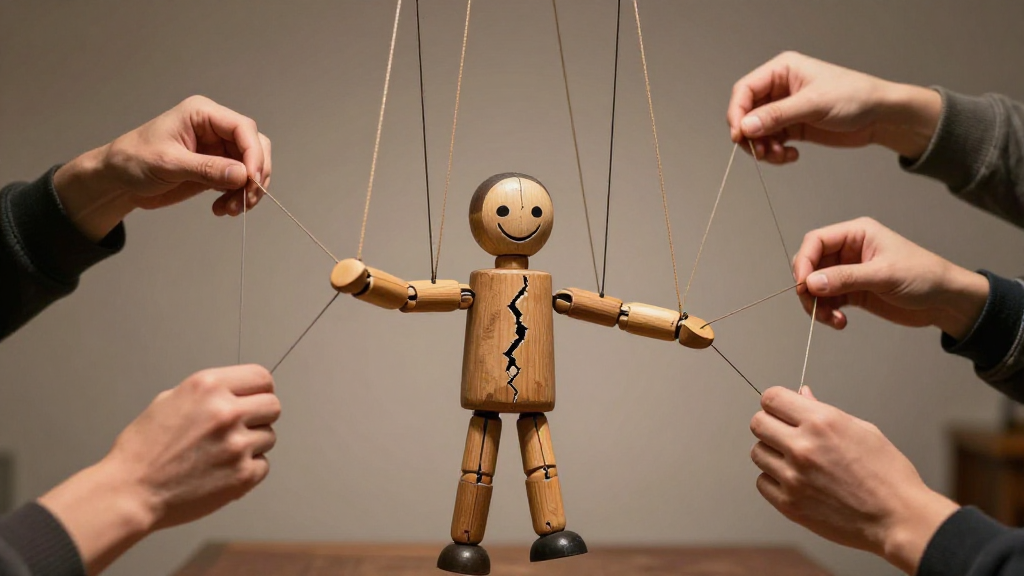
You're managing five departments while your colleagues manage one. You've been handed seven additional projects because others couldn't deliver. Your father calls late at night expecting you to solve problems that could wait until morning. Your mother needs constant answers. And somehow, despite all this competence and capacity for others, you walk past the same items twenty times without putting them in the cupboard.
The strangest part? You can strategize restructuring projects that will determine your team members' futures, but you can't respond to an email when you already know the answer. You threw a birthday party for your puppy and brought the whole neighborhood together, but basic tasks for yourself feel like climbing mountains.
For twelve months, you've been telling yourself you need more motivation. Better systems. Stronger willpower. But what if the problem isn't that you lack these things-what if you're experiencing something most people never recognize?
BEHIND THE CURTAIN
Here's what's happening in your brain when someone asks you for something:
The moment they make the request, your mind automatically starts racing. You're thinking through every detail of what they need, how to make it work, whether they'll be disappointed if it's not perfect. You don't choose to start this process-it just happens, like a reflex you can't control.
That automatic response looks remarkably similar to what happens in substance addiction.
Research on people-pleasing behaviors shows the same brain patterns as drug addiction. The anticipation of making someone happy triggers dopamine release, creating a reward cycle. When you successfully help someone, you feel relief and happiness that they're happy. But it's temporary. Then you're looking for the next thing to fix, the next person to help.
That temporary relief followed by seeking the next fix? That's the escalating pattern researchers see in addiction.
And when you try to say no? You can't sleep at night worrying if the person is okay. In addiction research, those are withdrawal symptoms. Your body has become dependent on that dopamine hit from pleasing others. When you withhold it by saying no, you experience actual physiological distress-restlessness, anxiety, obsessive worry.
Your brain is running an addiction cycle you never signed up for.
THE WRENCH IN THE WORKS
Here's where the mechanism malfunctions in a way that destroys your life:
You have energy for tasks that feed the addiction-making others happy. The work projects, the seven extras, managing five departments while others manage one. But tasks that only benefit you? Those feel impossible. The cupboard is just for you. Nobody cares if you put your things away. So your brain registers it as worthless-no dopamine payoff.
This is why depression has hit so hard.
Imagine your energy system like your puppy's energy level. When a puppy is healthy, they have energy for play, rest, eating. But if that puppy was constantly running, never resting, only performing for treats from others, what would happen? They'd be exhausted. They'd stop eating, stop playing, just collapse.
Research shows that chronic stress from over-functioning doesn't just make you tired-it actually changes your stress response system. Your lows get pulled much lower. That's why putting something in a cupboard feels like climbing a mountain. Your nervous system is depleted from constantly dosing others with your energy while denying yourself.
Even your joy with your puppy gets channeled into serving others. You threw a birthday party-not just to enjoy your puppy, but to bring people together, to make them have a good time. Every moment of potential personal joy becomes another opportunity to feed the addiction.
The mechanism that's supposed to help you connect with others has hijacked your entire energy system.
WHAT NO ONE TOLD YOU
Here's the piece that almost no one talks about, the one that makes breaking this pattern so difficult:
The people around you are addicted too.
Your family calling late at night, your colleagues who only manage one department while you manage five, your boss who keeps adding projects-they're not just benefiting from your people-pleasing. They're dependent on your supply.
You've been their dealer.
Like any addict whose dealer cuts them off, they'll experience withdrawal when you establish boundaries. They'll protest. They'll push back. They'll tell you you're being selfish. Your mother will have to manage her own problems. Your colleagues will have to step up. They'll struggle at first, and they'll make sure you know about it.
And that's when your own withdrawal symptoms will be strongest.
This is why people around you won't tell you these home truths-they're benefiting from your addiction. They need you to keep saying yes. Their comfort depends on your depletion.
In my fifteen years working with high-functioning people-pleasers, this is the factor that determines whether someone recovers or stays stuck: whether they understand that the resistance they'll face isn't evidence they're doing something wrong. It's evidence that others were depending on something that was destroying you.
THE FLIP THAT FIXES IT
The standard approach to people-pleasing goes like this: Set boundaries with everyone. Learn to say no. Put yourself first.
But after working with hundreds of people in your situation, I discovered something counterintuitive: you can't go cold turkey with everyone at once. Your nervous system can't handle that much withdrawal. Neither can theirs.
The approach that actually works is the opposite: strategic disappointment.
You deliberately choose to disappoint one person in a low-stakes situation. Not all seven projects-that would trigger massive withdrawal. Not your entire family-that would be unbearable. One boundary. One person. One disappointment.
You mentioned one project that keeps expanding in scope. You could push back on the latest addition-agree to the original scope but not the extras. Or your father calling late at night. You could set a boundary: no calls after 9pm.
Pick one. Let one person be disappointed. And observe what happens-both in them and in you.
When you communicate that boundary, your addiction will tell you to over-explain, apologize profusely, soften it so much you end up agreeing to half anyway. Addictive behavior always negotiates for partial doses.
Instead, you'll state it once, clearly, without apology: "I'll complete the original scope as agreed. The additional requests will need to be assigned elsewhere." Or "I won't be answering calls after 9pm. We can talk in the morning."
Then comes the critical part: you sit with the withdrawal symptoms.
Your brain will scream at you. You'll imagine them upset, disappointed, struggling. You'll feel physical anxiety. But instead of acting on it, you'll say: "This is withdrawal from my people-pleasing addiction. This discomfort is my nervous system healing."
Every time you sit through the withdrawal without giving in, you're literally rewiring your brain's reward system. Research on habit change shows it takes consistent practice to build new neural pathways. You won't feel better immediately. You'll feel worse at first.
But that discomfort isn't evidence you're doing something wrong. It's evidence you're breaking an addiction that was destroying you.
THE UNCOMFORTABLE TRUTH
Here's what this means you can no longer ignore:
You're managing five departments in a restructuring where people you care about face redundancy. But you're so depleted from people-pleasing everyone else that you can barely think straight about strategy. You're probably not protecting them as well as you could if you had more energy.
Every extra project you take, every late-night call you answer, every cupboard you walk past because you've spent all your energy on others-that's energy you could be using to genuinely help the people you care about most.
The people who've been taking from you aren't the ones who truly matter. But they've been getting your best energy because they ask for it and your addiction delivers it.
This means accepting that setting boundaries isn't selfish. It's strategic resource management. And it means accepting that some people will be angry when you stop being their supply. Their anger doesn't make you wrong. It makes them uncomfortable with having to meet their own needs.
You've been dosing others with your energy while denying yourself. That ends now.
THE CHALLENGE
Here's what I want you to do:
Choose one boundary you've been avoiding. The project scope expansion. The late-night calls. One of those seven extra projects.
Set that boundary this week. State it clearly, once, without apology. Then do nothing. Don't follow up with explanations. Don't check if they're okay. Don't soften it.
And when the withdrawal hits-because it will hit-I want you to write down what you're feeling. The anxiety. The obsessive worry. The urge to fix it. Write it down and label it: "Withdrawal symptoms."
Don't act on it. Just observe it.
Then watch what happens. Not just in your body, but in their response. Do they actually fall apart? Or do they figure it out? Does the world end? Or does it keep turning?
This isn't a comfortable exercise. It's a revealing one.
WHAT YOU'LL PROVE
When you complete this challenge, you'll prove something most people never discover:
That the stories your addiction tells you-that people need you, that you're responsible for their feelings, that saying no makes you selfish-are lies designed to keep the addiction running.
You'll prove that discomfort isn't damage. Withdrawal symptoms don't mean you made the wrong choice. They mean you're breaking a pattern that was breaking you.
You'll prove that you can be competent and helpful without being depleted and self-denying.
And you'll have evidence-real, lived evidence-that the people who truly care about you will respect your boundaries. And the people who don't? They were never respecting you in the first place. They were using you.
That's the difference between connection and addiction. And once you see it, you can't unsee it.
What's Next
Stay tuned for more insights on your journey to wellbeing.



Comments
Leave a Comment