

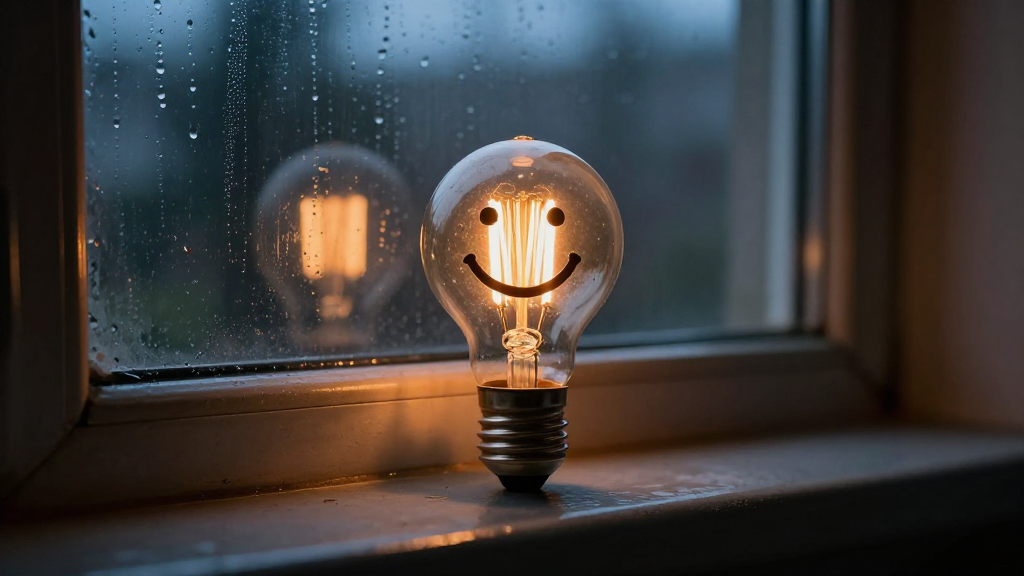
You used to be the person who lit up rooms. Colleagues described you as bubbly, the one who lifted everyone's spirits. Friends relied on your positivity. You brought sunshine everywhere you went.
And now? You feel muted. Squished. Like someone turned down your volume until you can barely hear yourself anymore.
You're exhausted in a way that sleep doesn't touch. Your confidence has evaporated. You look in the mirror and don't recognize the person staring back. The spark that defined you—the thing that made you you—has gone out, and you have no idea how to get it back.
If this sounds familiar, you've probably tried the usual advice. Set better boundaries. Practice self-care. Get away from toxic people. Maybe you've even wondered if there's something clinically wrong—if you need medication or therapy to fix whatever's broken inside you.
But here's what almost no one tells you: the reason you lost your spark has nothing to do with what you think.
3 Wrong Explanations for Lost Spark
When bright, giving people lose themselves, we typically blame one of three things:
Option 1: You're too nice. You let people walk all over you. You need to toughen up, stop caring so much what others think, learn to say no. Your people-pleasing tendencies are a character weakness you need to overcome.
Option 2: You're in a toxic situation. Your manager is terrible, your workplace is draining, your relationship is unhealthy. Once you get out of this particular situation, you'll bounce back to your old self.
Option 3: You're burning out. You need better self-care. More bubble baths. Meditation apps. Vacation time. You're running on empty and just need to refill your tank.
Here's the problem with all three explanations: they don't explain why this keeps happening.
If it were just about being "too nice," why do you feel like trying to set boundaries makes you physically anxious? Why does saying no feel like you're doing something fundamentally wrong?
If it were just this one toxic situation, why have you noticed this pattern before—in previous jobs, past relationships, family dynamics? Why do exploitative people seem to find you specifically?
And if it were just about needing more self-care, why does a relaxing weekend do absolutely nothing to restore that fundamental sense of aliveness you've lost?
The conventional wisdom is missing something critical. And until you understand what's really happening, you'll keep dimming no matter how many boundaries you try to set.
The People-Pleasing Secret Nobody Mentions
Here's what's actually going on, and it's going to sound counterintuitive:
Your tendency to bring sunshine to others isn't separate from your vulnerability to toxic people—they're connected.
Research on people-pleasing patterns reveals something most advice completely overlooks. People-pleasing isn't just a personality quirk or a bad habit you picked up. It's a measurable psychological pattern with three distinct dimensions: how you think, how you behave, and how you feel. And studies show it often originates as something called a fawn response—a trauma-based adaptation where your nervous system learned that managing other people's emotions equals safety.
Think about where you first learned to be the sunshine person.
For many people who lose their spark this way, if you trace it back far enough, you'll find a childhood where someone else's emotions felt dangerous. Maybe you watched a parent sacrifice themselves to keep the peace with a difficult partner. Maybe you learned that being bright and positive was the best way to diffuse tension. Maybe you discovered that making other people feel good was how you stayed safe, valued, or loved.
Your nervous system is incredibly good at learning. And what it learned was this: Bringing light to others = survival.
That adaptation worked. It probably worked brilliantly. You became genuinely good at uplifting people, at making others feel seen and valued. You developed a real capacity for positivity that people noticed and appreciated. That sunshine quality became part of your identity—maybe the part you valued most about yourself.
But here's the sad irony that no one talks about:
The very quality that makes you wonderful—that genuine ability to bring light—also makes you visible to people who will exploit it.
Why Toxic People Keep Finding You
Exploitative people aren't random. They don't distribute themselves evenly across the population, affecting everyone equally.
They're attracted to specific signals. And the combination of sunshine personality plus people-pleasing tendencies sends a signal like a beacon: Here's someone who will give endlessly. Here's someone who feels responsible for my emotions. Here's someone who won't fight back when I take more than I give.
This explains why toxic people keep finding you. It's not bad luck. It's not that you're "choosing wrong." It's that your particular combination of genuine warmth and learned fawn response creates a vulnerability that certain people can detect and will exploit.
And when you encounter these people—the micromanaging boss who contradicts your communications and tells clients you use "victim language," the partner who makes you responsible for their emotions, the family member who takes your caregiving as their due—something devastating happens.
You keep bringing sunshine. You keep trying to manage their emotions. You keep giving.
And slowly, inexorably, your light goes out.
What Happens When Caregiving Meets Toxic Work
There's a term in psychology research for what happens when you give intensively to others without any opportunity for replenishment: compassion fatigue.
Studies on caregivers show that when secondary traumatic stress converges with cumulative burnout, you don't just get tired. You experience a fundamental depletion of self. Your capacity for joy evaporates. Your confidence disappears. You lose your sense of purpose and identity.
This is what happened when you became a primary caregiver in crisis circumstances—staying in charity hostels, working from intensive care units, literally providing physical care—all without taking time off, all while trying to maintain your sunshine demeanor. Your body kept going, but your reserves were being consumed faster than any amount of "self-care" could replace them.
And here's where it gets worse: workplace research shows that toxic environments don't just add to your stress—they multiply it. When you're dealing with micromanagement, contradiction, and psychological undermining, studies document specific effects: 85% of people report decreased morale, 71% report impaired job performance, and most experience deteriorating self-esteem, confidence, and sense of self.
Compassion fatigue plus workplace toxicity doesn't equal double the problem.
It equals identity dissolution.
The exhaustion removes your capacity to recover from the workplace toxicity. The workplace toxicity prevents the recovery you need to process the exhaustion. And your people-pleasing response—that fawn adaptation that once kept you safe—keeps you absorbing it all instead of protecting yourself.
No wonder you feel like you've lost yourself. No wonder the spark is gone. No wonder you're so tired you could sleep forever and it still wouldn't be enough.
This isn't happening because you're weak. It's happening because you're experiencing the documented, predictable outcome of a perfect storm.
What Nobody Tells You About People-Pleasing
Here's where everything changes:
People-pleasing isn't a character flaw. It's not something wrong with you. It's something that happened to you—and your nervous system adapted brilliantly to keep you safe.
That adaptation created real gifts. Your ability to read rooms, to sense what people need, to bring genuine warmth and light—those aren't fake. They're real capacities you developed.
But those same capacities, without understanding and protection, made you vulnerable to people who would exploit them.
The question isn't "How do I stop being a sunshine person?" (You'd lose something essential to who you are.)
The question isn't "How do I get tougher?" (Suppressing your warmth isn't the answer.)
The question isn't even "How do I set better boundaries?" (When people-pleasing is a nervous system response, willpower-based boundaries feel impossible.)
The real question is: How do I understand this pattern deeply enough to heal it—so I can bring light without creating the conditions for my own extinguishing?
Research on interventions for burnout and people-pleasing patterns points to something called self-compassion as one of the most effective approaches. Studies show that for every one-unit increase in self-compassion, burnout decreases by approximately 0.45 to 0.49 units—that's a large effect size in psychological research.
But self-compassion in this context doesn't mean bubble baths and positive affirmations.
It means recognizing that your people-pleasing isn't a personal failing—it's a physiological state. Your amygdala becomes hypervigilant, perceiving any potential conflict as a danger to your emotional safety. This isn't a mindset you can think your way out of. It's a nervous system pattern that needs understanding and, eventually, updating.
4 Things You Need to Know Now
If you're reading this and recognizing yourself, here's what you need to know:
First: You're not broken. You're experiencing measurable human responses to circumstances that would deplete anyone. The combination of learned fawn response, intensive caregiving, and documented workplace toxicity would extinguish anyone's spark. This isn't mysterious. It's not personal failure. It's cause and effect.
Second: The pattern can be understood. Once you see how your sunshine quality plus people-pleasing adaptation creates vulnerability to exploitative people, you can start recognizing the signal before you're deep in depletion. You can learn to distinguish between "I'm not good enough" (the message toxic environments send) and "I'm in a situation designed to make me question myself" (what's actually happening).
Third: You already have evidence that protected brightness is possible. Think about the relationships where you feel like yourself—where you can relax, where you don't have to perform or manage anyone's feelings, where people accept you even when you're not bubbly. Those relationships exist. They prove you can be in connection without self-erasure. The work ahead involves understanding why some relationships feel this way and others demand your disappearance.
Fourth: Getting your spark back isn't about willpower. It's about recognizing the neurobiological reality of trauma responses, understanding how beautiful qualities can create vulnerabilities, and learning to activate your self-soothing system instead of constantly activating your threat response through people-pleasing.
Researchers studying self-compassion describe it as activating a soothing system that helps you respond to anxiety and stress differently. The more you practice recognizing people-pleasing as an adaptive response rather than a personal failing, the more that soothing system develops—and the less you need to rely on the fawn response that's been exhausting you.
How to Find Your Spark Again
Your spark didn't go out because you failed at something.
It went out because you encountered the specific circumstances where sunshine people with people-pleasing patterns become most vulnerable: intensive demands for caregiving, workplace environments designed to undermine confidence, and exploitative people who recognized your tendency to give without limit.
Understanding this doesn't instantly restore your energy or your sense of self. The depletion is real. The exhaustion is real. The loss of identity is real.
But it shifts the question from "What's wrong with me?" to "What happened to me, and what pattern needs healing?"
It moves you from shame to understanding.
From character flaw to adaptive response.
From isolated incidents to connected pattern.
From mysterious loss to identifiable causes.
And that shift—that reframe—is where recovery begins.
Because once you understand why your light went out, you can begin the work of rekindling it in a way that doesn't require you to dim yourself or harden yourself or stop being the person who brings sunshine.
You just learn to bring it in ways that don't extinguish you in the process.
That person you used to be—bubbly, positive, lighting up rooms—isn't gone forever.
She's just been buried under months of self-sacrifice and invalidation, operating with trauma responses she didn't know she had, giving light to people who took it without reciprocity.
And now that you can see the pattern, you can begin excavating her. Gently. Carefully. With the understanding that she was never broken—just trying to survive with strategies that worked once but don't serve her anymore.
Your spark is still there. It's just waiting for you to understand it well enough to protect it.





Comments
Leave a Comment