

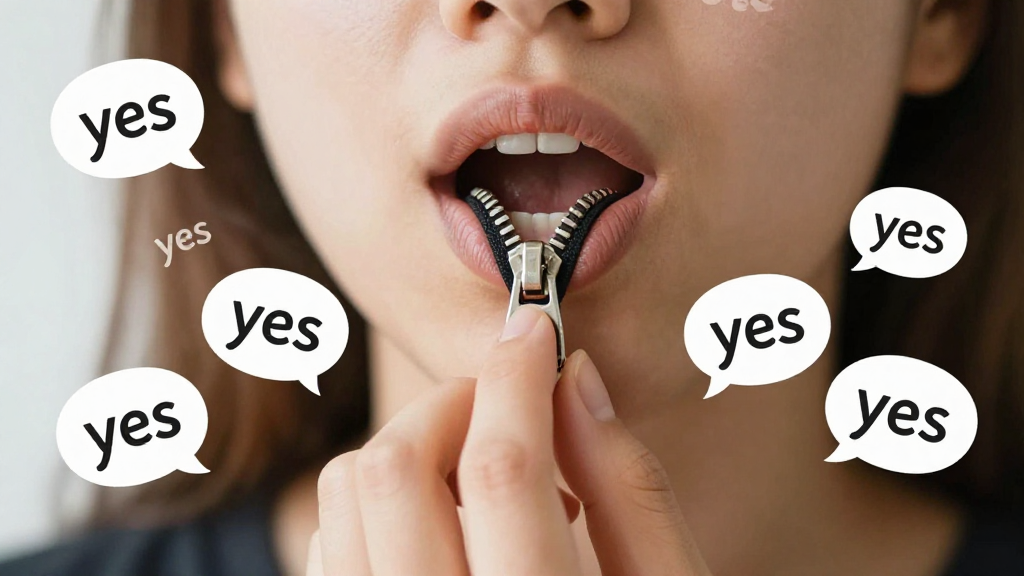
The 'Just Practice Saying No' Lie That Keeps You Stuck
Your partner just walked in with takeaway. Surprise. You had plans for the evening-nothing set in stone, but plans nonetheless. He's smiling, proud of himself for being thoughtful. The food is already bought. Already paid for.
And your brain goes blank.
Not angry blank. Not thoughtful blank. Just... blank. Like someone hit a switch and your ability to form preferences disappeared. You hear yourself saying "oh, thanks" while some part of you watches from a distance, confused about what just happened.
Later, you'll feel frustrated with yourself. Why couldn't you just say something? Why did you freeze? It's not like he forced you. You technically had a choice.
Except it didn't feel like a choice at all.
What Your Freeze Response Is Actually Telling You
For years, advice about assertiveness has told us the same thing: if you can't say no to people, you need to be stronger. More confident. Practice saying no in the mirror. Rehearse scripts. Build up your willpower.
The story goes like this: saying no is a skill like any other. Some people are naturally good at it, others need practice. If you find yourself agreeing to things you don't want, it's because you haven't developed this skill yet. You're too accommodating. Too worried about others' feelings. Too afraid of conflict.
The solution? Get comfortable with discomfort. Push through the awkwardness. Remember that "no" is a complete sentence.
You've probably tried some version of this. Maybe you've practiced boundary statements. Reminded yourself that your needs matter too. Promised yourself that next time, you'll speak up.
And then someone walks in with takeaway you didn't ask for, and your carefully rehearsed boundaries evaporate like they never existed.
The Missing Piece Every Boundary Book Ignores
Here's what neuroscience research actually shows: when you encounter situations that violate your autonomy unexpectedly, your prefrontal cortex-the decision-making part of your brain-can temporarily go offline.
Read that again. Your brain isn't failing you. It's responding to a perceived threat to your agency.
That blank feeling? That freeze? It's not weakness. It's your nervous system detecting that something is wrong with the decision-making environment you've just been placed in.
Think about it: when your grandmother's care home situation came up and your mother made those discouraging comments-"you're too busy," "it's too far for you"-you eventually went anyway. You found purpose in those visits. Connected with the nurses. Felt strong about being there.
What was different? Time.
You had space to process what was happening. To recognize the manipulation. To access what you actually wanted beneath the pressure.
With the takeaway, you had none of that. The choice architecture was already constructed: refuse and seem ungrateful, or accept and lose your evening. Neither option honored your actual autonomy. You were being asked to make a decision at the exact moment when your capacity to access your authentic preferences had been compromised.
The problem isn't that you can't say no. The problem is that you're being asked to make real decisions in conditions specifically designed to prevent real decision-making.
THE PIECE THEY LEFT OUT
Almost every book on boundaries focuses on what to say and how to say it. But there's a critical timing factor they're completely overlooking: decision latency.
Decision latency is the time gap between when you receive a stimulus and when you're required to respond. When that gap shrinks to near-zero, your capacity to consult your true preferences diminishes dramatically.
This isn't about being indecisive. This is about how human cognition actually works.
Research shows that when we're ambushed with requests that demand immediate responses, we can't properly access our own wants. Our brain needs processing time to:
- Recognize what's being asked
- Check against our existing plans and preferences
- Weigh the actual costs and benefits
- Formulate an authentic response
Surprise requests that demand instant answers exploit this timing gap. They hack our consent by removing processing time.
Your partner buying takeaway without asking first? That's decision latency manipulation. By the time you're aware a decision is needed, the clock is already at zero. The money is spent. He's standing there expectantly. Your window for accessing your authentic preference has already closed.
Your mother saying "you're too busy" to visit your grandmother? Same mechanism, but you had the luxury of time to recognize it and override it. Hours or days to think "wait, am I too busy? No, I'm not. I want to go."
The difference between the situations where you successfully maintained your autonomy and the ones where you froze isn't your strength or skill. It's whether you had the time gap you needed to think.
And here's what almost no one mentions: you can buy yourself that time gap. You don't need the perfect response in the moment. You just need one sentence: "I need a minute to think about this."
Not a decision. Just time to make one.
The Hidden Mechanism Running Your Relationship
Now here's the invisible mechanism running behind all of this-the thing that explains why this pattern keeps showing up in your relationships.
When you're constantly monitoring another person's mood and adjusting your behavior accordingly, you're running two nervous systems simultaneously: yours and theirs.
Researchers call this hypervigilant accommodation.
Think about what you described with your partner: he's on "better behavior" while waiting for the relationship discussion, but triggers still cause mood shifts. Even when he's calm, you're tracking. Is he okay? What's his energy like? Should I mention this thing or wait? Will this comment land well or set something off?
That's exhausting because you're not just managing your own emotional state-you're attempting to predict and prevent his.
Now compare that to your experience with the nurses at the care home. With your best friend in your weekly accountability meetings. You show them furniture pictures for your new house. You laugh. You talk freely. You're not performing emotional calculations before each sentence.
The difference isn't the people. It's that in those relationships, you're only running one nervous system: your own. You're not responsible for managing their emotional responses to your preferences.
Here's how this connects to the freeze response:
When you've been practicing hypervigilant accommodation long enough, your brain gets trained to prioritize the other person's state over your own preferences. It becomes automatic. So when your partner walks in with surprise takeaway, your nervous system instantly begins computing: He spent money. He's proud. He's trying. If I say no, he'll be hurt. If he's hurt, I'll need to manage that. Managing that is exhausting. Better to just accept.
All of that happens in the split second before conscious thought.
Your freeze isn't you being unable to access your preferences. It's your nervous system rapidly calculating that expressing your preferences will cost more energy than suppressing them.
The mechanism is running on autopilot, making decisions for you before you're consciously aware a decision is being made.
And the most insidious part? This gets presented to you as choice. He didn't force you. You could have said no. You chose to accept the takeaway.
But choice requires access to your decision-making capacity. And in that moment, with zero decision latency and a nervous system trained to prioritize his emotional state over your authentic preferences, you didn't actually have access to choice.
You had the illusion of choice. That's very different.
What This Means for Every 'Choice' You've Made
Once you see this pattern-the decision latency manipulation, the hypervigilant accommodation, the nervous system running calculations before conscious thought-new questions emerge.
If your freeze response is actually information, what other responses you've been treating as failures might actually be signals? That stomach drop when someone suggests plans. That sudden tiredness when you're asked to do something. That inexplicable irritation that seems to come from nowhere.
If buying decision latency ("I need a minute to think") works for surprise requests, what about situations where the pressure is more subtle? When someone doesn't ambush you with takeaway but instead says "I was thinking we could..." with that particular hopeful tone that makes refusing feel cruel?
If you're running two nervous systems in your romantic relationship but only one with friends, what does that mean about the relationship itself? Is this something you can fix by setting better boundaries, or is the hypervigilant accommodation pointing to something unfixable in the dynamic?
And perhaps most unsettling: if you've gotten so practiced at the autonomy-erosion dance that your body responds before your conscious mind even registers what's happening, how many decisions that felt like your choices actually weren't?
The One Question That Changes Everything
But here's the question that changes everything:
What would it feel like to be in a relationship where you never had to buy yourself decision latency-because no one was ambushing you with pre-made decisions in the first place?
Not because you got better at boundaries. Not because you practiced saying no. But because you were with someone who naturally respected the time gap you need to consult your own preferences.
Someone who asked "what do you want for dinner?" before buying it. Who said "I'm noticing I'm getting triggered, I need to take some space" instead of mood-shifting and leaving you to perform emotional meteorology. Who treated your autonomous decision-making as something to protect, not something to work around.
You already know what this feels like. You're experiencing it with the nurses at the care home. With your best friend. You show them house pictures and plan furniture arrangements and you don't think twice about whether they're okay with your preferences.
That ease you feel in those relationships isn't because those people are less important. It's because they're not asking you to run their nervous system for them.
So the question isn't "how do I get better at saying no?"
The question is: "Why am I in a relationship where I need to buy decision latency just to access my own preferences?"
How to Trust What Your Body Already Knows
You'll find your answer not by analyzing the relationship, but by noticing how your body responds in different contexts.
Pay attention to where you feel that ease-the places where you're just yourself, where preferences flow naturally, where you're not calculating emotional impact before speaking. Notice what those environments have in common.
Then pay attention to where you feel that freeze. That blank. That sense of running computations you didn't consciously choose to run. Notice what triggers it.
Your nervous system already knows the answer. It's why you're 100% clear you want to be single. Why you're happier, calmer, more at peace just knowing you're going to leave. Why pictures of your future house feel light and free.
The discovery process isn't about gathering more evidence or achieving more clarity. You already have clarity.
It's about trusting that the freeze response was information all along. That your body was trying to tell you something important about the decision-making environment you've been living in.
And that choosing to leave a relationship where you constantly need to buy yourself decision latency isn't you failing at boundaries.
It's you finally listening to what your nervous system has been saying the whole time.
What's Next
Stay tuned for more insights on your journey to wellbeing.





Comments
Leave a Comment