

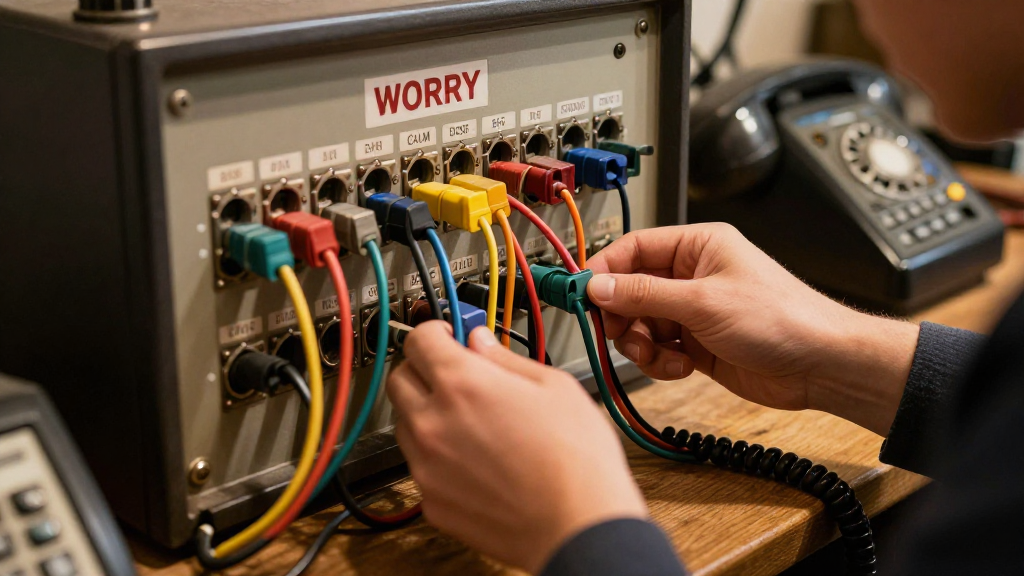
You're sitting in a meeting that hasn't started yet. Just two minutes of waiting. And already your mind is replaying that email you sent this morning-should you have worded it differently? Then it jumps to the presentation next week. Then to whether you're falling behind on that project.
It happens on the train. Between tasks. In any moment that isn't completely filled with work. The second there's space, your brain floods it with worries. You've tried to stop it. You've tried the techniques-noticing the thoughts, challenging them. Sometimes they work. Sometimes they don't. But here's what you've discovered: you can't just switch off worry and leave nothing there. Your mind needs something to do, or it slides right back to the worry track.
And underneath it all, there's this feeling that you should be able to control this. That if you just tried hard enough, you could make your brain stop.
But what if the problem isn't that you're not trying hard enough? What if there's something happening behind the scenes that you've never seen?
5 Hidden Reasons Your Brain Defaults to Worry
Here's what most people don't realize is happening when worry feels automatic:
Your brain has been running a program for years-maybe decades. Every time there's a "dead moment" with no immediate task, your brain treats it as processing time. And what does it process? Problems. Worries. Things that might go wrong. Things you might have done wrong.
This isn't random. You've trained your brain to do this.
Think about how you've approached life. University where anything less than 100% felt like failure. Early career with fourteen to sixteen hour days, working every bank holiday. Even now, after changing jobs because of burnout, you're still pushing the same way. Results over everything else.
In that environment, what happens to downtime? It becomes work time. Your brain learns: "Empty moments are for solving problems, preparing for threats, preventing failure."
And here's the invisible mechanism that makes this stick: worrying feels productive. It feels like you're doing something. Like you're preparing, planning, problem-solving. Happy thoughts feel like a waste of time when there's actual stuff to figure out.
So your brain defaults to worry the same way it might default to checking email. It's become your brain's automatic "work" during any gap.
3 Ways Worry Pretends to Be Productive
But here's where this system malfunctions:
Most of what you worry about isn't actually solvable in the moment. You're replaying a meeting from earlier-can you change what you said? No. You're projecting worst-case scenarios about next week-can you control outcomes that haven't happened yet? No.
You're not actually preparing. You're just creating stories about unknowns.
And here's the part that might surprise you: when you worry about genuine unknowns-outcomes you can't control yet, things that haven't happened-your worst-case scenario is actually just as much wishful thinking as a best-case scenario.
Both are stories you're making up.
Research on prospective thinking shows that humans have systematic biases in both positive and negative directions when imagining futures. The negative projection isn't more realistic just because it feels worse. When you're dealing with actual uncertainty, catastrophizing isn't caution-it's just one flavor of speculation.
So your brain is running this automatic program: "Use empty moments for productive worry." But the "productive" part is an illusion. You're not solving anything. You're suffering twice-once if something actually goes badly, and again now while you imagine it.
The mechanism that was supposed to help you prepare has become the thing that's burning you out.
2 Secrets About Positive Thinking Nobody Mentions
Here's the piece almost no one mentions:
You can't build a new thought pattern using vague positivity. "Everything will be fine" doesn't work because it's empty-it has no detail, no texture. It can't compete with the sophisticated, detailed worry vocabulary you've spent years developing.
You know how to worry in high definition. You can imagine seventeen variations of what might go wrong in that presentation, each with specific consequences. But positive thinking? It's just a fuzzy "things will work out," which your brain immediately dismisses as naive.
This is why the techniques feel inconsistent. You're trying to fight a detailed, practiced mental pattern with a vague alternative.
What you need isn't less worry-it's equally detailed vocabulary for neutral and positive thinking zones.
And here's the second piece that changes everything:
You mentioned you can't really picture your life past three or four years. You want everything straight away. That limited time horizon is directly connected to your urgency problem.
When you can only see three years ahead, every goal feels critical right now. Every delay feels like failure. You're running a marathon, but you can't see the finish line, so every mile feels like it might be the last one you can handle-which means you have to sprint.
But something interesting happened when you thought about buying a house. Originally you wanted to buy at thirty-five. Then you considered forty instead. And that five-year extension actually felt... acceptable. Less pressure.
Same house. Same goal. But extending the time horizon made it feel different.
Research on temporal discounting shows this mathematically: when you extend your time horizon, the perceived urgency of near-term goals decreases. A five-year delay is catastrophic in a three-year window. In a sixty-year window? It's a rounding error.
So the forgotten factors are: (1) You need detailed, practiced positive vocabulary, not vague optimism. (2) You need to extend your time horizon from three years to sixty years, which transforms what actually matters.
1 Counterintuitive Strategy That Actually Works
The standard approach to worry is this: Notice the worry thought, challenge it in the moment, try to let it go, calm yourself down.
You've tried this. It's inconsistent. Sometimes it works, sometimes it doesn't.
Here's why: You're trying to learn a new language while someone's shouting at you. You're attempting to rewire thought patterns during crisis mode-when your brain is already hijacked by the worry spiral.
Studies on cognitive restructuring show something counterintuitive: effective thought pattern change happens through practice during calm states, not during acute stress.
Think about athletic training. You don't figure out your running form during the race. You practice when you're not under pressure, building the muscle memory so it's available when you need it.
The same applies to your brain.
So here's the reversal: Stop trying to fight worry in the moment. Instead, practice the substitution patterns when you're calm-building the neural pathways ahead of time.
Twice a day, during a calm moment-morning coffee, before bed-spend two minutes actively practicing:
Question 1: "What's one specific thing going well right now?"
Not "my relationship is good." That's vague. Instead: "My relationship with my girlfriend has improved significantly. Specifically, we're communicating better-when I'm stressed, I tell her instead of just being irritable. And she's been really supportive about the house search, even when I get obsessive about details."
Feel the difference? You're giving the positive thinking texture, detail, specificity. You're building vocabulary.
Question 2: "What does my sixty-year-old self need from me today?"
This question extends your time horizon in real-time. Picture yourself at sixty. In your home. Maybe the one you're buying now. Your girlfriend-probably wife by then-is there. Maybe kids who are adults by that point.
Does that version of you thank your current self for sprinting anxiously through the next thirty years? Or does he thank you for something else?
When one client tried this exercise, he had a profound realization: "It's not just ruining my day or ruining two years until I get stuff. It might actually ruin the thirty years from sixty onwards."
That's the shift. When you practice these questions during calm moments-not during worry spirals-you're building alternative tracks. Your brain is creating detailed, practiced pathways that become available during those "dead moments."
You're not trying to leave a void. You're pre-loading the substitution.
The 60-Year Reality Check You're Avoiding
Here's what this means you can no longer ignore:
You've been running a marathon like it's a sprint. For fifteen years or more. University, early career, and even now after changing jobs-you haven't fundamentally changed your approach.
You've always prioritized results over health and well-being. And when you could only see three years ahead, that made a certain kind of sense. Sacrifice now for the payoff soon.
But you're not in a three-year window. You're in a sixty-year window.
And looking after yourself throughout the marathon isn't secondary to finishing-it's necessary to reach the end. Stress reduction isn't a luxury or a distraction from practical problem-solving. It's the most practical thing you can do for your long-term performance.
If you keep running the next thirty years at sprint pace, burned out and anxious, what condition will you be in at sixty? What will you have sacrificed? What relationships will have suffered while you optimized for the next promotion?
The honest implication is this: The way you've been operating might have gotten you here, but it won't get you to sixty in any condition you'd want to be in.
7-Day Test: Build Alternative Thought Tracks
Here's what I want you to test:
For the next seven days, practice the two-minute substitution exercise twice daily. Morning and evening. Set a timer.
Not during worry spirals. Not when you're stressed. During calm moments.
Ask the two questions:
1. "What's one specific thing going well right now?" (Answer with concrete details)
2. "What does my sixty-year-old self need from me today?"
Two minutes. Twice a day. Seven days.
That's it.
I'm not asking you to stop worrying. I'm not asking you to challenge every negative thought. I'm asking you to build the alternative vocabulary while you're calm, so it's available when you need it.
And here's the dare: If you actually do this-if you practice when calm instead of fighting worry in crisis-you'll notice something change. The automatic worry program will start to have competition. Not because you're fighting it, but because you've built equally detailed alternative tracks.
4 Things You'll Discover About Your Brain
If you complete this challenge, here's what you'll discover:
First, you'll prove that detailed positive thinking is learnable. It's not about being naive or lying to yourself. It's about building vocabulary for what's actually going well with the same sophistication you've built for what might go wrong.
Second, you'll prove that extending your time horizon changes what feels urgent. When you regularly connect with your sixty-year-old self, the five-year delay on buying a house stops feeling like failure. The extra promotion or two stops being worth your health. The whole urgency equation shifts.
Third, you'll prove that you can rewire the default tracks. Your brain currently fills dead moments with worry because that's the practiced pathway. But you can build new pathways-not by fighting the old ones during crisis, but by practicing alternatives when calm.
And finally, you'll prove something that might be the most important: You're not broken. You don't lack willpower or discipline. You've just been running an automatic program that made sense in one context (sprint to the next achievement) but doesn't make sense in another (sustained performance over sixty years).
The program can be changed. The time horizon can be extended. The vocabulary can be built.
But only if you stop trying to fix it in the moment and start training when you're calm.
Seven days. Two minutes twice daily. That's the test.
What's Next
Stay tuned for more insights on your journey to wellbeing.
References
- Kross, E., & Ayduk, O. (2017). Self-distancing: Theory, research, and current directions. Advances in Experimental Social Psychology, 55, 81-136. https://doi.org/10.1016/bs.aesp.2016.10.002





Comments
Leave a Comment